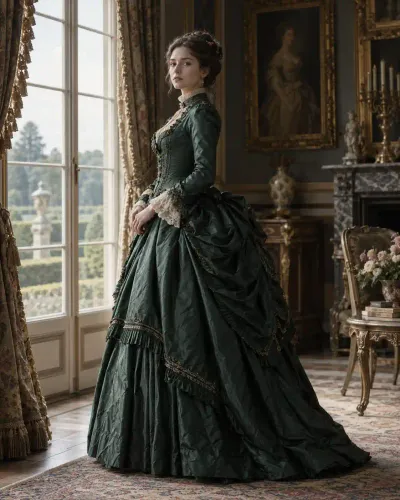
The Victorian Era
1837–1901
From crinolines to bustles - six decades of dramatic, rapidly-shifting silhouettes.
Silhouettes
-
Bustle Era, First Phase
The crinoline collapses toward the back of the body as the bustle emerges - skirts narrow at front, elaborately draped and trimmed behind.
-
Bustle Era, Second Phase
The bustle returns, larger and more shelf-like than its 1870s predecessor, before collapsing again by decade's end.
-
Crinoline Era
The cage crinoline replaces heavy petticoat layering, enabling the era's dramatic, rapidly-inflating bell-shaped skirts.
-
Early Victorian / Romantic
A natural waistline drifting into a dropped shoulder, with wide skirts still supported by layered petticoats rather than a cage.
-
Late Victorian / Gibson Girl (1890s)
Leg-of-mutton sleeves and the hourglass silhouette usher in a more tailored, athletic ideal that carries straight into the Edwardian era.
-
Natural Form Era
A brief, notably slender, close-fitting silhouette between the two bustle phases - often overlooked but a genuinely distinct look.
Designers
-
Charles Frederick Worth
Generally credited as the father of haute couture and the first designer to put his own name and label inside a garment.
-
Department-Store Ready-Mades
By the century's final decades, department stores began offering standardized ready-made garments alongside made-to-measure dressmaking - a real counterweight to the bespoke model that had defined most of the era.
-
Dressmaker vs. Designer
For most of the Victorian period, clothing was made by dressmakers working from a client's own measurements and current fashion plates - not 'designed' in the modern sense.
-
Godey's Lady's Book
The most influential American fashion periodical of the era - its hand-colored fashion plates set trends more directly than any single individual for most of the century.
-
Jeanne Paquin and the House of Paquin
One of the very few women running a major Paris couture house in her own name during this era - a genuinely rare exception to a trade otherwise dominated, at the top, by men.
-
Redfern
A tailoring house that adapted menswear construction techniques to womenswear, becoming closely associated with the era's tailored walking suit and a more sportswear-influenced silhouette.
Garments
-
Bloomer Costume
A short skirt worn over loose trousers gathered at the ankle - popularly named for Amelia Bloomer, though she didn't design it, and the dress reform movement's most famous, and most mocked, practical alternative to crinolines and corsets.
-
Cage Crinoline
A light steel-hooped frame that emerged around 1856 - credit is genuinely disputed among competing French and English patents - that replaced heavy layered petticoats and let skirts balloon dramatically without the weight.
-
Corset
The foundational structural garment of Victorian dress, shaping the torso to whatever silhouette a given sub-period demanded.
-
Gloves and Etiquette
A near-mandatory accessory governed by genuinely elaborate etiquette - when to wear them, when to remove them, and what it signaled if you didn't.
-
Mourning Dress
A genuinely distinct category of Victorian dress - specific fabrics, colors, and cut governed by strict, codified stages of mourning.
-
Mourning Jewelry
Jewelry made from jet, hairwork, or black enamel, worn as part of formal mourning dress - a genuinely distinct craft tradition that grew directly out of the era's strict mourning customs.
-
The Bonnet's Evolution
The Victorian bonnet shrank, tilted, and reshaped itself dramatically across the era's six-plus decades, tracking many of the same silhouette shifts happening below the neckline.
-
The Tailor-Made Walking Suit
A tailored jacket-and-skirt combination borrowed from menswear tailoring, built for actually walking rather than standing decoratively - a real shift in what dress was for.
Fabrics & Textiles
-
Aniline Dyes and Mauveine
The first commercially successful synthetic dye, mauveine, discovered in 1856, opened up a vivid new color palette that natural dyes simply couldn't produce at scale.
-
Cotton and Calico
Cheap, washable, and mass-produced at industrial scale - the fabric most Victorian women actually wore day to day, standing in real contrast to the silk and velvet this section otherwise spends so much time on.
-
Lace
Hand-made bobbin and needle lace gave way over the century to machine-made lace, a shift that mirrors the era's broader move from hand construction to mechanized production.
-
Mourning Crape
A dull, crimped silk fabric reserved almost exclusively for the earliest and strictest stage of mourning dress.
-
Silk
One of the two dominant fibers of Victorian dress, prized for its drape and sheen across day, evening, and mourning wear alike.
-
Velvet
A dense, pile-woven fabric associated with wealth and formality - a staple of eveningwear and winter dress throughout the era, and one of the fabrics most transformed by industrial-era production.
-
Wool Tweed
A rugged, textured wool associated with the tailored walking suit and the era's increasingly practical, outdoor-oriented late-century womenswear.
Construction & Fit
-
Bustle Mechanisms
A close look at how the bustle was actually built - wire cage structures in the first phase versus the more elaborate, shelf-like pad-and-frame structures of the second - and how the engineering differs between them.
-
Corsetry and Boning
The construction techniques behind Victorian corsetry - boning materials, channeling, and lacing - that make every silhouette in the era possible.
-
Glove-Fitting Bodice Construction
The extremely close, second-skin bodice fit that defined later Victorian silhouettes, achieved through precise seaming and boning rather than the corset alone doing all the work.
-
Hand-Sewing to Machine-Sewing
The domestic sewing machine's spread from the late 1850s onward is a real inflection point - construction gradually shifts from entirely hand-worked to machine-assisted across the rest of the era.
-
The Bodice Dart's Evolution
Dart placement and count shifted considerably across the era's silhouette changes, from the simpler shaping of early Victorian bodices to the more elaborate princess-seamed construction of the 1890s.
-
The Cage Crinoline as Structure
A close look at the cage crinoline as wearable structural engineering - hoop spacing, materials, and how the frame actually holds its shape.
Culture & Context
-
Class and Dress
Victorian dress made class distinctions visible at a glance - fabric quality, trim, and sheer quantity of fabric all signaled status, and elaborate dress required servant labor most households didn't have.
-
Colonial and Imperial Trade
Britain's imperial trade networks shaped which fabrics and dyes were available and affordable throughout the era - cotton, silk, and indigo among them - tying fashionable dress directly to colonial extraction.
-
Department Stores and Mail-Order Catalogs
The rise of the department store and the mail-order catalog put fashionable dress within reach of far more households than bespoke dressmaking ever could.
-
Mourning Customs
Strict, codified mourning customs - especially after Victoria's own extended mourning for Albert from 1861 - shaped a whole distinct category of Victorian dress.
-
The Dress Reform Movement
A real, if minority, pushback against corsetry and crinolines - from bloomers to aesthetic dress - arguing Victorian fashion was actively harming women's health.
-
The Lady's Maid and the Labor of Dressing
Getting in and out of a fully structured Victorian gown often required another person's hands entirely - a labor dependency that shaped who could actually wear the era's most elaborate fashions.
-
Victoria's Influence Beyond Mourning
Beyond her decades of mourning dress, Victoria's own choices - including popularizing the white wedding dress - shaped fashion norms that outlasted her reign considerably.