The Victorian Era Crinoline era (1850s–1860s)
The Cage Crinoline as Structure
A close look at the cage crinoline as wearable structural engineering - hoop spacing, materials, and how the frame actually holds its shape.
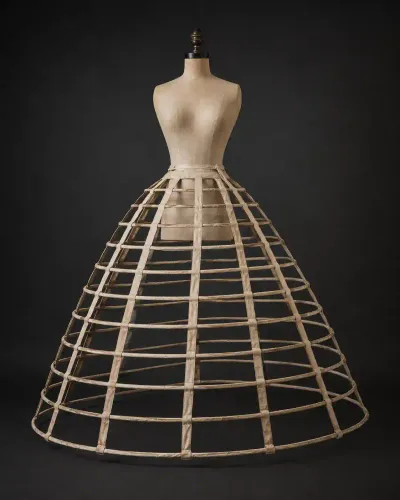
Where the Garments entry on the cage crinoline covers it as an object, this one is about how it's actually built - hoop spacing, the tapes that hold the steel bands in place, and why the engineering matters as much as the silhouette it produces.
The build itself is straightforward in principle, clever in execution. A series of flat or half-round steel hoops - typically somewhere between six and twelve, graduated from narrowest at the waist to widest partway down the skirt, then tapering slightly again toward the hem - are held in vertical alignment by a set of fabric or ribbon tapes running the height of the cage, usually stitched at regular intervals so each hoop stays evenly spaced from its neighbors rather than sliding out of position. The whole assembly attaches at the waist with its own separate waistband, worn like a garment in its own right rather than sewn into anything, which is part of why cage crinolines survive in such numbers in museum collections today - they were a standalone, replaceable piece of equipment, not integrated into a specific dress. Hoop spacing determined the finished shape as much as hoop size did: cages spaced more tightly near the waist and widening gradually produced the smoother, more bell-like early-1860s silhouette, while later cages, flattened deliberately at the front hoops and left fuller at the back, are the crinoline visibly transforming itself into a bustle structure before the word "bustle" was even in common use.
Set next to what replaces it, the engineering logic is almost a full reversal. The cage crinoline suspends volume all around the body from a single point at the waist - it's fundamentally a hanging structure, gravity pulling the hoops downward and outward evenly in every direction. The bustle mechanisms that follow it, especially the hinged second-phase versions, are closer to cantilevered structures, projecting weight outward from one side (the back) rather than distributing it evenly, which is a genuinely different engineering problem and explains why bustle hardware - hinges, articulated joints - looks nothing like a crinoline's simple graduated hoops despite both being, at bottom, steel skirt supports. I don't think it's an exaggeration to call the shift from crinoline to bustle one of the more interesting quick pivots in the whole history of structural garment engineering, and it happens within about a decade.