The 1950s
1950–1959
The New Look's afterglow, the wiggle dress, and the birth of teen fashion.
Silhouettes
-
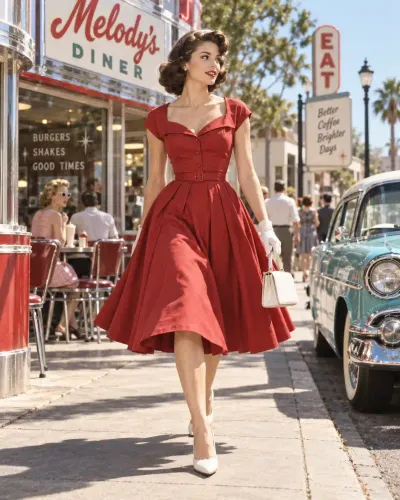
The New Look
Christian Dior's 1947 debut silhouette - a cinched waist over a wide, fabric-heavy skirt - that set the tone for the first half of the decade before shapes like the wiggle dress took over.
-
The Sack Dress
A straight, unfitted chemise that hung loose from the shoulder - the decade's last silhouette, and its most controversial.
-
The Shirtwaist Dress
A button-front bodice borrowed from menswear shirting, paired with a full or slim skirt - the era's most versatile daywear shape.
-
The Trapeze Line
A triangular, unfitted shape flaring from a narrow shoulder to a wide hem - Yves Saint Laurent's first collection as head of Dior, and the silhouette that bridges the decade's tailored shapes into the looser 1960s.
-
The Wiggle Dress
A close-fitting, knee-length sheath that narrowed toward the hem, forcing the short, mincing steps that gave it its name.
Designers
-
Chanel's 1954 Comeback
After a fifteen-year hiatus, Coco Chanel reopened her house in 1954 with a collection built around the comfortable, tailored suit that would define her second act.
-
Christian Dior
The New Look's architect - cinched waists and yards of skirt fabric that reset the decade's silhouette after wartime austerity.
-
Claire McCardell
The pioneer of American sportswear - practical, mass-producible clothes designed for how women actually moved and lived.
-
Cristóbal Balenciaga
A Spanish couturier working in Paris, known for architectural precision and sculptural silhouettes - often cited by his own peers as the finest technician of his generation.
-
Hubert de Givenchy
Opened his own Paris house in 1952 at 24 or 25 (sources vary on exactly when relative to his February birthday), known for elegant, wearable separates and the start of a close working relationship with Audrey Hepburn.
-
Norman Norell
Known as the 'Dean of American Fashion' - tailored day suits and glittering sequined 'mermaid' evening gowns, brought to ready-to-wear with couture-level construction.
-
Pauline Trigère
A French-born, New York-based designer known for precise draping and cutting, and one of relatively few women running her own American fashion house at the time.
Garments
-
Capri Pants
Cropped, fitted trousers that hit mid-calf - a casual, faintly rebellious counterpoint to the decade's full skirts.
-
Circle Skirt
A skirt cut from a full circle of fabric so it falls in even, sweeping fullness - the poodle skirt's plainer, more versatile cousin.
-
Cocktail Dress
A between-length dress pitched between daywear and a full evening gown - tailored for a new mid-century social ritual: the cocktail party.
-
Halter Sundress
A casual, bare-shouldered warm-weather dress with a strap that ties or fastens behind the neck - a relaxed counterpoint to the decade's more structured silhouettes.
-
Poodle Skirt
A felt circle skirt appliquéd with a poodle motif - pure teenage novelty wear, and probably the single most recognizable garment of the decade, even though it actually originated in the late 1940s.
-
Saddle Shoes
Two-tone lace-up leather shoes with a contrasting 'saddle' panel across the instep - a campus and teen-culture staple, usually worn with bobby socks.
-
Sweater Set
A matched cardigan-and-pullover pair, often in cashmere or lambswool - quintessential preppy daywear, usually finished with a string of pearls.
-
Swing Coat
A loose, flared coat cut wide through the back to swing away from the body - practical outerwear built to accommodate the era's full underlying skirts.
-
The Bikini
Introduced in 1946 and still genuinely controversial a decade later - a two-piece swimsuit that took years of slow, resistant mainstreaming before it stopped being a scandal and started being ordinary beachwear.
Fabrics & Textiles
-
Felt
A dense, non-woven wool fabric that doesn't fray at a cut edge - exactly why it became the material of choice for appliquéd circle and poodle skirts.
-
Gingham
A checked cotton weave that became shorthand for wholesome, girlish daywear across the decade.
-
Novelty Atomic Prints
Playful screen-printed cotton featuring boomerangs, starbursts, and atomic motifs - the fabric expression of the decade's fascination with the Space Age and nuclear science.
-
Nylon
The decade's defining synthetic - cheap, durable, and easy-care, and the fiber that made affordable stockings and easy-wash blouses possible.
-
Orlon Acrylic
DuPont's acrylic fiber, marketed from 1950 as a wool alternative - lightweight, moth-resistant, and easy-care in exactly the way the decade's synthetics were prized for.
-
Rayon
A semi-synthetic fiber made from wood pulp, cheaper than silk and widely used for linings and everyday dresses throughout the decade.
-
Taffeta
A crisp, tightly woven fabric prized for its structure and characteristic rustle - a go-to for full-skirted party and eveningwear that needed real body.
Construction & Fit
-
Boned Bodices
Structural boning built into a bodice to hold its shape and support the bust without a separate corset underneath.
-
Boning for Strapless and Halter Eveningwear
Internal boning built into a strapless or halter bodice to keep it up and shaped without any shoulder support at all - a real engineering problem eveningwear had to solve.
-
Crinolines and Petticoats
The stiffened, layered underskirts that gave full 1950s skirts their volume and swing.
-
Interfacing and Structured Collars
Stiffened fabric layered inside a collar or cuff to hold its shape crisply - a small, unglamorous detail doing a lot of work in the decade's tailored shirtwaist dresses and blouses.
-
Shoulder Pads
Structured pads set into a bodice's shoulder seam to square and lightly build up the shoulder line - a quieter, more restrained holdover from 1940s tailoring.
-
The Bullet Bra and Conical Construction
A bra built from spiral-stitched concentric circles rather than a smooth, rounded cup - producing the decade's distinctive sharp, pointed bust line rather than a natural silhouette underneath it.
-
The Zipper's Spread
Metal zippers became a fully standard closure in women's fashion during the 1950s - not because they were new, but because they'd finally recovered from wartime metal restrictions that had curtailed their use since the early '40s.
Culture & Context
-
Bettie Page and Pin-Up Culture
A single pin-up model's photographs circulated far outside official fashion channels - and quietly kept a bolder, more body-conscious style alive underneath the decade's otherwise buttoned-up public face.
-
Car and Drive-In Culture
The rise of car ownership and drive-in culture - movies, diners - helped push casualwear like capri pants, sweater sets, and saddle shoes into genuinely mainstream daily use.
-
Cold War Conservatism
Fashion's return to structured, traditionally feminine silhouettes has been read by historians as part of a broader postwar push back toward conventional domestic roles amid Cold War anxiety.
-
Conformity Culture and Dress
The decade's anxious political climate fed a broader cultural pressure toward conformity, visible in how codified 'appropriate' dress became for both men and women.
-
Hollywood's Costuming Influence
Studio costume designers dressed the era's biggest stars, and what appeared on screen filtered straight down into what ordinary women wanted to wear.
-
Postwar Rationing's Tail End
Formal clothes rationing in Britain and France actually ended by 1949 - but Dior's fabric-hungry 1947 New Look landed squarely while it was still in force, which is exactly why it read as so radical, and why the memory of scarcity still shaped spending well into the new decade.
-
The Growth of Ready-to-Wear
Department stores and mass manufacturers scaled up standardized sizing and factory production, making fashionable clothing dramatically more accessible than the couture and dressmaker model that came before.
-
The Rise of Teen Fashion
Building on a teen market that had already emerged during the war years, the 1950s is when 'teenager' becomes a fashion market with real money behind it - its own look, separate from both children's and adult women's clothing.