The 1950s mid-1950s
Saddle Shoes
Two-tone lace-up leather shoes with a contrasting 'saddle' panel across the instep - a campus and teen-culture staple, usually worn with bobby socks.
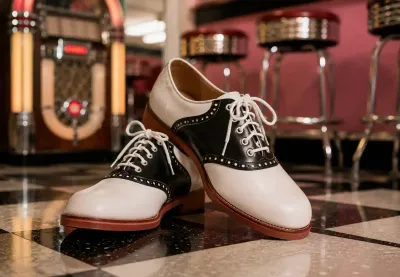
Saddle shoes are practically shorthand for 1950s teen style now, right alongside the poodle skirt - sturdy, a little boyish, and built for a decade that was suddenly marketing directly to teenagers instead of just their mothers.
The shoe itself dates back well before teenagers claimed it - saddle shoes originated in the 1900s–1910s as athletic footwear, the contrasting leather "saddle" panel across the instep originally there for reinforcement during hard lateral movement on a tennis or golf court, not for looks. By the 1920s and '30s they'd become a genuine collegiate staple, worn by both men and women on university campuses as sturdy, practical footwear suited to walking a large campus daily - which is exactly the context that sets up their 1950s life. When the decade's marketers and media started treating teenagers as a distinct consumer group with its own aspirational style, collegiate dress was one of the most obvious references to draw on, since college itself represented a genuinely aspirational, slightly older-and-cooler identity for a high schooler to borrow from.
Paired with bobby socks and a poodle skirt or circle skirt, saddle shoes complete what's become the single most recognizable "1950s teenager" outfit in the popular imagination - sock hops, soda fountains, drive-in culture, all typically pictured with this exact shoe on the ground. What I find genuinely interesting is that the shoe's practical original virtues - durability, a low stacked heel suited to actually walking and standing all day, real structural support - never really left it even as its cultural meaning shifted completely, from tennis-court reinforcement, to collegiate practicality, to a specifically teenage fashion statement. It's a good reminder that a garment's function and its cultural meaning can drift almost entirely independently of each other over a few decades.