The 1950s mid-to-late 1950s
The Rise of Teen Fashion
Building on a teen market that had already emerged during the war years, the 1950s is when 'teenager' becomes a fashion market with real money behind it - its own look, separate from both children's and adult women's clothing.
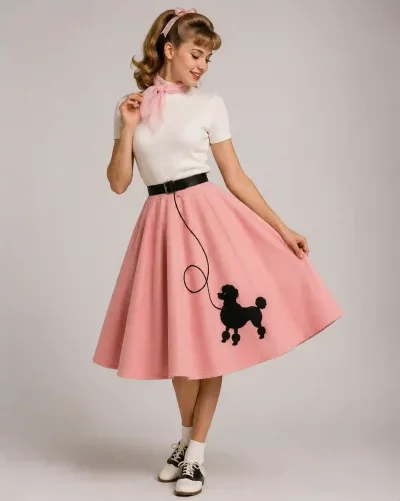
This is one of my favorite threads in the whole decade, though the real starting point is actually the war years - Seventeen magazine launched in 1944 explicitly chasing a teen-girl readership, and wartime "bobby-soxer" culture already had marketers paying attention. What the 1950s adds is scale: real, growing disposable income turns that emerging teen market into something poodle skirts and saddle shoes could be built around specifically.
The economics behind this are really the whole story, once you look past the specific garments. Postwar prosperity didn't just raise household income generally - it created, for a broad swath of American families for really the first time, enough surplus income that a teenager could plausibly receive a regular allowance rather than every dollar in the household being allocated to necessities. That's a genuinely new category of independent purchasing power sitting inside the household, distinct from a parent's own spending decisions, and marketers noticed almost immediately: by the mid-1950s, "the teenage market" was a phrase advertisers and manufacturers used unselfconsciously, with real research and dedicated product lines built specifically around it, rather than teenagers simply being sold scaled-down versions of adult or children's clothing as an afterthought.
What that independent purchasing power actually let teenagers do was participate directly in a specific fashion identity of their own choosing, rather than simply wearing whatever their mother selected or approved - which is exactly why garments like the poodle skirt and saddle shoes, both cheap enough for a teen allowance or a part-time after-school job to cover, spread as fast and thoroughly as they did through actual peer networks rather than through mothers coordinating over department-store catalogs. I think that's the real hinge this whole entry turns on: "teenager" stops being simply a biological age category and becomes, for the first time at this scale, a genuine consumer identity with its own money, its own specific style vocabulary, and its own channels - school, radio, teen magazines - for spreading trends independently of the adult fashion system running in parallel to it. Everything else in this section's teen-culture entries is really downstream of that one underlying economic shift.