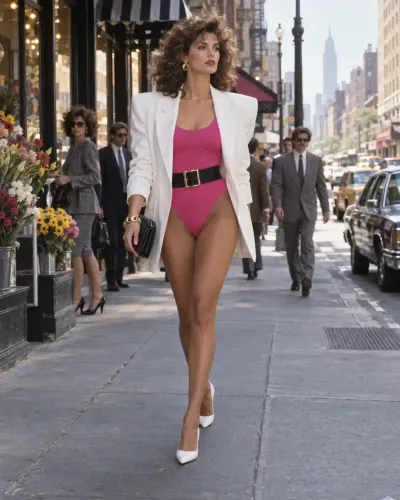
The 1980s
1980–1989
Padded shoulders and power suits, aerobics-studio spandex, and prom-night excess - the decade fashion got loud, structured, and unapologetically maximalist.
Silhouettes
-
The Aerobics Silhouette
A leotard, leg warmers, and a headband worn straight out of the studio and onto the street - the moment activewear stopped being something you changed out of before anyone saw you in it.
-
The New Romantic Silhouette
Ruffled shirts, exaggerated volume, and deliberately blurred gender lines - a theatrical, dandyish look built for a generation raised on music videos rather than concert halls.
-
The Power Silhouette
Padded shoulders, a nipped waist, and a hemline that stops at the knee - the shape a generation of women reached for to look unmissable in rooms men had run alone until recently.
-
The Preppy Silhouette
Polo shirts with popped collars, kilts and khakis, cable-knit sweaters knotted over the shoulders - a buttoned-up, old-money look that opened the decade before power dressing and spandex took over.
-
The Prom Silhouette
Puffed sleeves, a boned strapless bodice, and a skirt with enough tulle underneath to fill a doorway - the decade's closing statement on how much volume and shine one eveningwear silhouette could carry.
Designers
-
Azzedine Alaïa
Nicknamed 'the King of Cling' - a Tunisian-French designer whose precisely engineered stretch-knit dresses proved body-conscious construction could be genuinely sophisticated rather than merely athletic.
-
Christian Lacroix
The couturier whose 1987 debut collection and exuberant 'le pouf' bubble skirt gave the decade's back half its most maximalist, most-imitated eveningwear silhouette.
-
Claude Montana
A French designer whose leather-and-shoulder-pad tailoring made severity itself the point - broad, sharp, uncompromising silhouettes that read as armor as much as clothing.
-
Donna Karan
The designer behind 'Seven Easy Pieces' - a 1985 capsule collection built explicitly around a real working woman's actual day, and the closest this decade gets to genuinely practical power dressing.
-
Norma Kamali
The American designer who took sweatshirt fleece seriously as eveningwear fabric and built a whole collection - and a whole idea about what activewear could become - out of that one unlikely decision.
-
Ralph Lauren
The American designer who turned old-money Americana into a fully purchasable lifestyle brand - the commercial engine behind this decade's preppy explosion as much as any single handbook was.
-
Stephen Sprouse
A downtown New York designer who put graffiti lettering and day-glo color directly onto ready-to-wear, collapsing the distance between street art, punk, and the runway years before that felt like an obvious move.
-
Thierry Mugler
The French designer who took the padded shoulder to its most extreme, architectural conclusion - building a body that looks engineered rather than dressed, somewhere between a superhero and a luxury car.
Garments
-
Leg Warmers
Knitted or stretch-fabric tubes pulled up over the calf, borrowed wholesale from ballet studios - worn scrunched down over tights and sneakers by people who had never taken a dance class.
-
Stirrup Pants
Fitted stretch-fabric trousers finished with a fabric loop that hooks under the foot, keeping the hem pulled taut down the length of the leg rather than riding up or bunching.
-
The Bodysuit
A snug, one-piece leotard worn as a top, snapped closed between the legs to stay put under a skirt or trousers - the base layer the decade's whole body-conscious activewear look was actually built on.
-
The Mini Backpack Purse
A scaled-down backpack, sized like a handbag and carried the same way - a small practical answer to a decade that wanted a woman's hands free without giving up carrying a purse at all.
-
The Off-the-Shoulder Sweatshirt
A plain sweatshirt with the neckline cut wide and left to slide down one shoulder - dance-studio utility repurposed, almost overnight, into one of the decade's most copied casual looks.
-
The Parachute Pant
A loose, tapered trouser cut from tough, slightly shiny ripstop nylon and cinched at the ankle - built to survive breakdancing floor spins that would tear an ordinary pair of pants apart.
-
The Pinstripe Skirt Suit
A blazer and skirt cut from the exact pinstriped wool suiting fabric a male banker down the hall would be wearing - borrowing menswear's authority signal at the level of the cloth itself, not just the cut.
-
The Power Tie and Bow Blouse
A blouse finished with an oversized bow at the neck, or a genuine necktie borrowed outright from menswear - the one deliberately feminine detail power dressing's borrowed-from-men silhouette still made room for.
-
The Shell Suit and Tracksuit
A matching zip-up jacket and elastic-waist trouser in shiny, rustling nylon - built for a running track, worn everywhere else instead, loud color-blocking included.
-
The Shoulder-Pad Blazer
A structured, single- or double-breasted jacket built around a genuinely wide, padded shoulder line - the single garment most responsible for putting the decade's power silhouette on real office floors.
Fabrics & Textiles
-
Acid-Wash Denim
Denim deliberately faded in an irregular, mottled pattern using a chemical wash process - manufactured distress standing in for years of genuine wear, sold new rather than earned over time.
-
Neon and Fluorescent Synthetics
Synthetic fabrics dyed in colors bright enough to seem to glow under ordinary light - a genuinely new color category that natural dyes on natural fibers simply couldn't produce convincingly.
-
Pastel and Pattern-Clash Prints
Soft pinks, mints, and lavenders printed in deliberately mismatched geometric patterns and layered together on purpose - a Memphis-design-influenced palette that made clashing itself the point.
-
Rubber and Jelly Accessories
Molded PVC and rubber, cast into stacks of colorful bangles and translucent jelly shoes - cheap, durable materials that let an accessory be worn dozens at a time without real cost or weight.
-
Sequins and Lame
Metallic thread and reflective plastic discs, applied densely enough to turn a whole garment into a light source - the finishing touch the decade's maximalist eveningwear kept reaching for.
-
Spandex and Lycra
An elastane fiber that stretches and recovers its shape without any structural boning or built-in tension - the material that made body-conscious clothing something a body could actually move in.
-
Taffeta and Tulle
A crisp, structured woven silk or synthetic and a fine, stiff netting - paired together to give the decade's eveningwear skirts the volume and rustle no soft, draping fabric could deliver alone.
Construction & Fit
-
Batwing and Dolman Sleeve Draping
A sleeve cut in one continuous piece with the bodice, widening dramatically from wrist to underarm - a way to build huge visual volume into an arm without adding real weight or restricting movement.
-
Boned Strapless Bodice Construction
Vertical rigid supports sewn into a fitted, strapless bodice lining - the internal structure that lets a garment with no straps at all stay put through an entire evening of dancing.
-
Shoulder Pad Construction
Foam or felted-wool inserts built into a garment's shoulder seam, widening the visible shoulder line well beyond a wearer's actual anatomy - engineering authority into a silhouette rather than tailoring around a body that already had it.
-
Stretch and Spandex Construction
Building a garment from fabric that does the fitting work itself, rather than from darts, boning, or precise pattern-cutting - a genuinely different relationship between cloth and body than most tailoring assumes.
-
The Asymmetric Hemline and Mullet Hem
A skirt or dress cut deliberately shorter in front and longer in back - a single unbalanced hemline doing the work of two different lengths at once, and refusing to settle on either.
-
The Leg-of-Mutton Sleeve Revival
A sleeve cut full and puffed at the shoulder, narrowing sharply at the elbow to a fitted forearm - a Victorian-era shape brought back for a completely different eveningwear moment a century later.
Culture & Context
-
Big Hair and Aerosol Styling Culture
Hairspray and mousse sales climbed right alongside hemlines and shoulder pads - height and volume in the hair became just as much a status signal as anything actually being worn underneath it.
-
Cyndi Lauper and Thrift-Store Eclecticism
A playful, deliberately mismatched thrift-store aesthetic - clashing prints, layered vintage pieces, wildly dyed hair - offered a genuinely different pop-star fashion model than Madonna's more provocative club-kid look.
-
Dynasty and Prime-Time Soap Glamour
A weekly prime-time soap opera turned shoulder pads, sequins, and sheer opulence into appointment viewing - and gave the decade's power silhouette its most unapologetically glamorous, least office-practical showcase.
-
Hip-Hop and Early Streetwear
A Bronx-born music and dance culture that built its own distinct fashion vocabulary from the ground up - practical, brand-conscious, and largely ignored by the mainstream fashion press until well after it had already spread nationwide.
-
Jane Fonda and the Aerobics Boom
A 1982 workout video turned a Hollywood actress into the unlikely face of a genuine national fitness movement - and, with it, made studio activewear something worth being seen in outside the studio.
-
Madonna and the Club Kid Influence
Layered lace, rubber bracelets, crucifixes worn as jewelry rather than devotion, underwear worn as outerwear - a downtown club-scene look one pop star's overnight fame carried straight into shopping malls nationwide.
-
MTV and Fashion
A cable channel that launched in August 1981 and turned musicians into a genuinely new kind of fashion authority - style spreading at the speed of a three-minute video rather than a seasonal runway show.
-
Power Dressing and Corporate Feminism
A real, measurable wave of women moving into management and executive roles created a genuine problem this decade's fashion industry answered directly: what does authority look like on a body it was never designed to signal for?
-
Princess Diana and Early-80s Dressing
A single 1981 wedding dress, with sleeves so dramatically puffed they needed their own supporting structure, put romantic eveningwear volume in front of a global television audience years before it became a runway staple.
-
The Preppy Handbook and Preppy Culture
A 1980 satirical guide to old-money dressing that readers took as genuine instruction rather than a joke, turning a narrow, class-specific style into a nationwide youth fashion movement almost overnight.