The 1980s mid-1980s
The Slogan T-Shirt
Big black capitals on an oversized white T-shirt - Katharine Hamnett's protest shirts, famously worn to meet Margaret Thatcher in 1984, and the 'FRANKIE SAY' shirts that turned the idea into pop merchandise.
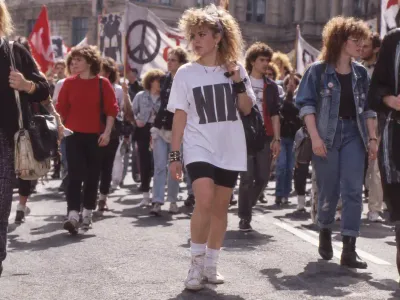
The slogan T-shirt is about as simple as clothing gets: a plain T-shirt with words printed on it. In the 1980s it became one of the decade's most powerful fashion statements - literally - and it's one of the clearest examples of clothes being used to say something.
Printed T-shirts weren't new. Punk had used them aggressively in the 1970s, with Vivienne Westwood and Malcolm McLaren's shop selling shirts covered with provocative text and images. But the 1980s version had a new, cleaner look. The British designer Katharine Hamnett began producing oversized white T-shirts with huge, bold, black capital letters in 1983, printed with short political messages: "CHOOSE LIFE," "WORLDWIDE NUCLEAR BAN NOW," "STOP ACID RAIN," "EDUCATION NOT MISSILES." They were designed to be read from across a street, or in a photograph.
The most famous moment came in March 1984, when Hamnett was invited to a Downing Street reception marking the first London Fashion Week. She arrived wearing a T-shirt reading "58% DON'T WANT PERSHING," referring to a poll showing majority opposition to American Pershing nuclear missiles being based in Europe, and shook hands with Prime Minister Margaret Thatcher in front of the press. The photograph went around the world, and the slogan T-shirt was established as a political weapon.
Pop music quickly turned it into merchandise too. In 1984, the record label ZTT, where Paul Morley devised the campaign for its band Frankie Goes to Hollywood, produced "FRANKIE SAY RELAX" T-shirts in the same bold, capitalised style, followed by "FRANKIE SAY WAR! HIDE YOURSELF" and others, and they became a massive craze, copied and bootlegged everywhere. Wham! wore Hamnett's "CHOOSE LIFE" shirts in the 1984 video for "Wake Me Up Before You Go-Go", which added to the effect, and MTV spread these images globally.
What I find fascinating about the slogan T-shirt is how it sits against the rest of 1980s fashion. The power suit and designer logos signalled money and status; the slogan tee used the same visual boldness to say something about politics, the environment, or simply the wearer's taste in music. It was cheap, democratic, and easy to copy, and it has been part of fashion ever since, from protest marches to designer runways.