The 1980s throughout the 1980s
Power Dressing and Corporate Feminism
A real, measurable wave of women moving into management and executive roles created a genuine problem this decade's fashion industry answered directly: what does authority look like on a body it was never designed to signal for?
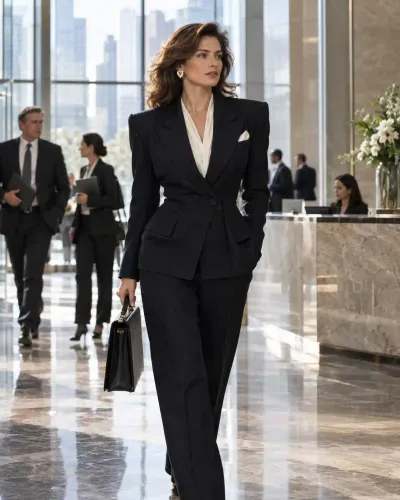
More women were entering management and executive positions through this decade than in any previous one, often as the first woman to hold a given role at a given company, and that created a real, practical wardrobe problem existing fashion vocabulary hadn't yet solved: corporate authority, as a visual language, had been built entirely around men's bodies and men's tailoring for the better part of a century. John T. Molloy's earlier "dress for success" guidance had already started pushing women toward suit-like structure in the workplace, but it's this decade where that advice crystallizes into a fully developed, widely adopted silhouette.
The power silhouette - broad, padded shoulders narrowing to a defined waist, a knee-length hem, a genuinely tailored blazer - is the direct fashion answer to this problem, and it's worth being clear-eyed about what it's actually doing: borrowing menswear's existing authority signals wholesale, rather than inventing an equivalent visual language built specifically around a woman's body. Donna Karan's explicitly practical "Seven Easy Pieces" collection, designed around an actual working woman's unpredictable eighteen-hour day, is probably the clearest instance of a designer treating this as a genuine problem to solve rather than a purely aesthetic trend to chase.
I think what makes this culture entry worth taking seriously, rather than filing it under "eighties shoulder pads" as a purely visual punchline, is the real tension sitting underneath it - dressing for authority by adopting a traditionally masculine silhouette is, at best, an ambiguous feminist statement, simultaneously claiming space in rooms that had excluded women and implicitly conceding that authority itself still looked, and dressed, like a man. That tension runs under nearly every power-dressing garment this decade produced, and it's part of why the whole silhouette reads, in hindsight, as more complicated than either straightforward empowerment or straightforward capitulation.