The 1930s
1930–1939
Bias-cut satin and Hollywood glamour on one side, Depression-era house dresses on the other - the decade the waist came back and the hemline dropped.
Silhouettes
-
The 1939 Nipped-Waist Silhouette
A sharply cinched waist, fuller and shorter skirts, and the return of the corset in Paris's last pre-war collections - a preview of the New Look that the war postponed by eight years.
-
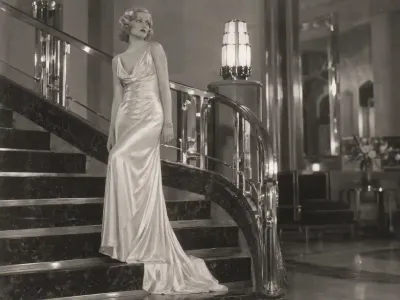
The Bias-Cut Evening Silhouette
The long, liquid, body-skimming evening gown cut on the diagonal of the fabric - the defining glamour silhouette of the decade, from Paris couture to the Hollywood screen.
-
The Broad-Shoulder Silhouette
Widened, padded, and puffed shoulders over narrow hips - an inverted-triangle line pushed by Schiaparelli in Paris and Adrian in Hollywood, and the direct ancestor of the 1940s square shoulder.
-
The Return of the Natural Waist
The abrupt end of the 1920s flapper line - waists climbing back to their natural position and hemlines dropping to mid-calf almost overnight, just as the stock market crashed.
-
The Trouser Silhouette
Wide-legged, high-waisted trousers worn off the beach for the first time - made glamorous by Marlene Dietrich and Katharine Hepburn, and still daring for most women by the end of the decade.
Designers
-
Adrian
MGM's chief costume designer, who dressed Garbo, Harlow, Shearer, and Crawford - and whose screen designs, from the Letty Lynton dress to the Eugénie hat, sold in department stores across America.
-
Coco Chanel
Already the most famous designer of the 1920s, Chanel spent the 1930s on a short Hollywood detour, costume jewellery, and a bitter rivalry with Schiaparelli - before closing her couture house at the outbreak of war.
-
Elsa Schiaparelli
The Italian-born Paris couturière who brought surrealism, shocking pink, visible zips, and the padded shoulder into fashion - Chanel's great rival, and the decade's wittiest designer.
-
Madeleine Vionnet
The couturière who turned the bias cut from a trimming technique into a whole way of making clothes - draping on a half-scale doll and building gowns that moved with the body rather than against it.
-
Mainbocher
The first American to run a successful Paris couture house - a former Vogue editor who dressed Wallis Simpson for her 1937 wedding and designed the famous 1939 corset photographed by Horst.
Garments
-
Beach Pyjamas
Loose, wide-legged trouser outfits for the beach and resort - the Riviera fashion that made it acceptable for fashionable women to be seen in trousers in public.
-
The Backless Evening Gown
A long evening gown cut away to the waist at the back - the 1930s' boldest piece of glamour, shifting fashion's focus from the legs of the 1920s to a bare, suntanned back.
-
The Depression House Dress
A cheap, washable, printed cotton day dress with short or puffed sleeves and a mid-calf hem - the garment most women actually wore through the Depression, far from Hollywood satin.
-
The Maillot Swimsuit
A close-fitting one-piece swimsuit with a low back and halter or narrow straps - made possible by new elastic yarns, and designed as much for sunbathing as for swimming.
-
The Tilted Hat and the Eugénie Craze
Small hats worn tipped over one eye - the defining millinery of the decade, sparked by a feathered 'Empress Eugénie' hat that Garbo wore on screen and everybody copied.
Fabrics & Textiles
-
Crepe de Chine and Rayon Crepe
Softly textured, fluid crepes in silk and increasingly in rayon - the everyday dress fabric of the decade, draping almost like satin at a fraction of the price.
-
Lamé and Metallic Fabrics
Fabrics woven or knitted with metallic threads in gold and silver - the Art Deco era's most dazzling evening material, and a Hollywood favourite for catching studio light.
-
Lastex and the Elastic Revolution
An elastic yarn made from a fine rubber core wrapped in cotton, silk, or rayon - the quiet innovation behind clinging swimsuits, two-way-stretch girdles, and the end of the rigid corset.
-
Silk Satin and Charmeuse
Lustrous, fluid silks with a glossy face and a matte back - the fabrics that made the bias cut shine, literally, on the dance floor and the cinema screen.
-
The Invention of Nylon
DuPont's fully synthetic fibre, first made in 1935 and announced in 1938 - unveiled to the public as stockings at the 1939 World's Fair, just in time to vanish into wartime parachutes.
Construction & Fit
-
Bra Cup Sizing and the Uplift Bra
The 1930s bra shaped and lifted the bust into two separate, rounded forms - and the introduction of lettered cup sizes let women buy a bra that actually fitted.
-
Godets and the Flared Hem
Triangular fabric inserts and shaped panels set into skirts to keep them slim over the hips but flaring at the hem - the everyday construction trick behind the decade's graceful line.
-
The Bias Cut
Cutting garment pieces at 45 degrees to the fabric's grain so they stretch, drape, and cling - the construction technique behind the decade's most famous gowns, and one of the hardest to master.
-
The Roll-On Girdle and the End of the Corset
Elastic girdles that could be pulled on without laces or hooks replaced the boned corset for most women - smoothing the hips for bias-cut dresses while letting the body move.
-
The Zipper Arrives
The zip fastener moved from boots and bags into fashion in the 1930s - shown off as decoration by Schiaparelli, adopted in menswear, and slowly working its way into women's dresses.
Culture & Context
-
Hollywood Glamour and the Silver Screen
In the golden age of the studio system, film costume designers became the most influential fashion voices in America - and department stores sold copies of what the stars wore.
-
Sport, Leisure, and the Suntan
Tennis, hiking, cycling, swimming, and sunbathing reshaped the ideal body and wardrobe of the 1930s - an athletic, tanned look that brought shorts, swimsuits, and beach pyjamas into fashion.
-
Surrealism and Fashion
The art movement of dreams and strange juxtapositions crossed into fashion in the 1930s - lobster dresses, shoe hats, and trompe l'oeil tears - mostly through Schiaparelli's collaborations with Dalí and Cocteau.
-
The Great Depression and Dress
After the 1929 Wall Street crash, mass unemployment and poverty reshaped how most people dressed - home sewing, mending, feed-sack cotton, and cheap copies of Hollywood styles.
-
The Wallis Simpson Effect
The American divorcée for whom Edward VIII gave up the throne in 1936 - and whose lean, immaculate, understated chic made her one of the most copied women of the decade.