The 1930s mid-to-late 1930s
Surrealism and Fashion
The art movement of dreams and strange juxtapositions crossed into fashion in the 1930s - lobster dresses, shoe hats, and trompe l'oeil tears - mostly through Schiaparelli's collaborations with Dalí and Cocteau.
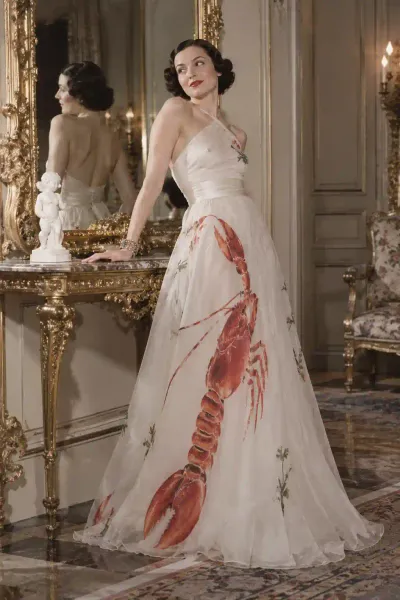
Surrealism was an art movement that began in Paris in the 1920s, interested in dreams, the unconscious, and unexpected combinations of everyday objects - a lobster on a telephone, a melting clock. By the mid-1930s it had become fashionable in its own right, and it crossed into fashion more directly than almost any art movement before it, thanks largely to one designer: Elsa Schiaparelli.
Schiaparelli collaborated closely with Salvador Dalí on some of the most famous pieces in fashion history. The lobster dress of 1937 was a white silk organza evening gown with a large lobster printed on the skirt, based on a Dalí design. The shoe hat of 1937-38 was a black felt hat shaped like an upside-down high-heeled shoe. The "Tears" dress of 1938 was printed with trompe l'oeil rips, as if the fabric had been torn, and came with a veil with real cut-out tears. The skeleton dress of the same year used padding to raise the shape of ribs and a spine. She also worked with Jean Cocteau, whose drawings were embroidered onto her evening coats, and her collections used buttons and jewellery shaped like insects, hands, and lips.
What I love about the surrealist moment in fashion is how it changed what clothes could be. For most of history, fashion had been about beauty, status, or practicality. Schiaparelli showed that clothes could also be jokes, provocations, and art - and that a dress could make you think as well as look good. Not everyone was convinced; plenty of people found it silly or unsettling. But the idea that fashion could be conceptual and witty, rather than merely pretty, runs from here through to designers working today. It's also a lovely counterpoint to the Wallis Simpson school of restrained chic - the 1930s had room for both.