The 1930s mid-to-late 1930s
The Bolero Jacket
A short, open jacket ending above the waist - the 1930s answer to wearing a backless evening gown to dinner, and a quick way to update a plain day dress.
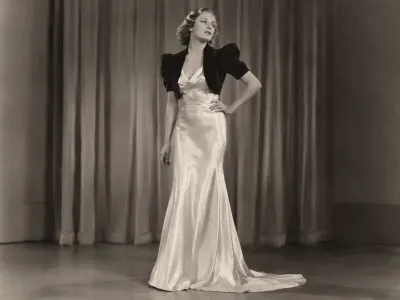
The bolero is a small garment that solved a big problem. The backless evening gown was the defining glamour dress of the decade, but a bare back wasn't always welcome at a dinner table, a formal reception, or anywhere with a draught. A short matching jacket fixed that neatly: wear it through dinner, take it off for dancing, and you've effectively got two outfits from one dress.
The shape itself comes from Spanish dress - the short, open jacket of the bullfighter and of regional costume - and it had come and gone in women's fashion before, including in the Victorian era. The 1930s version typically ended well above the natural waist, fastened with a single button or tie or not at all, and often had puffed, capped, or padded sleeves. That shoulder emphasis is the key to why it suited the decade so well. A bolero adds width at the shoulder and ends exactly where it frames the waist, so it reinforced the broad-shouldered, narrow-waisted line without adding any bulk below it.
For evening, boleros were made to match or contrast with the gown, in velvet, satin, lamé, sequins, or fur. Schiaparelli turned the short evening jacket into one of her main canvases - her late-1930s jackets, heavily embroidered by the Maison Lesage with circus, zodiac, and other themes, are among the most famous objects of the decade, and they work precisely because the gown underneath is kept plain. For day, the bolero was a sensible, economical piece: a little jacket over a plain crepe dress, often sold as a set, gave you a smarter, more "finished" look for the office or for lunch without the cost of a full suit.
I love the bolero for exactly that thrift. It uses very little fabric, it can be run up at home from a remnant, and it can make a tired dress feel new, which mattered in the Depression. Patterns for boleros were everywhere in the home-sewing magazines of the period. It's also one of the easiest 1930s pieces to wear today - a short cropped jacket over a slip dress still reads as quietly, unmistakably 1930s.