The 1930s throughout the 1930s (from the 1929 crash)
The Great Depression and Dress
After the 1929 Wall Street crash, mass unemployment and poverty reshaped how most people dressed - home sewing, mending, feed-sack cotton, and cheap copies of Hollywood styles.
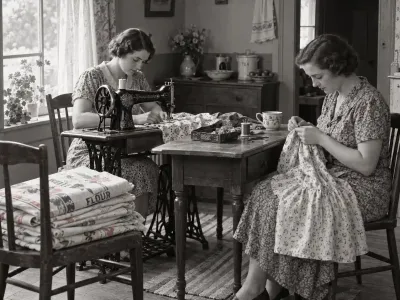
The Wall Street crash of October 1929 set off the worst economic depression of the modern era. By the early 1930s, around a quarter of the American workforce was unemployed, and much of Europe was in similar trouble. It's impossible to talk honestly about 1930s fashion without starting here, because for most people, the decade's clothes weren't about bias-cut satin or surrealist hats. They were about making a limited wardrobe last.
That meant a huge amount of home sewing. Cheap commercial patterns - Simplicity, founded in 1927, built its business on patterns that sold for 15 cents when the established brands charged around a quarter - let women make their own dresses from inexpensive fabric. Old clothes were remade, turned, mended, and handed down. In rural America, printed flour and feed sacks became dress fabric, the start of a practice that peaked in the 1940s. Ready-made clothes were available too, and got cheaper as mass production improved, with washable cotton house dresses and rayon crepe dresses that copied fashionable styles at low prices.
What I find most striking is how the Depression coexisted with the decade's glamour. The same years that saw breadlines and dust storms also produced the most extravagant evening gowns and the most glamorous film costumes in history. I don't think that's a contradiction. Hollywood sold escapism, and for a few cents at the cinema, people could watch stars in satin and lamé. Then they went home and adapted what they'd seen with whatever they had - a new collar, a tilted hat, a longer hem. The natural waist and longer hemline that opened the decade became, in homemade cotton, the look of a whole generation getting by.