The 1940s wartime and postwar (1941-1949)
Make Do and Mend: Remaking and Refashioning
The home techniques - unpicking, turning, re-cutting, darning, and reknitting - that kept wartime wardrobes going, and turned a husband's old suit into his wife's new one.
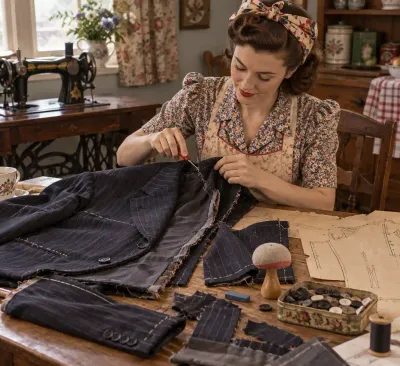
Make Do and Mend was the title of a 1943 pamphlet from Britain's Board of Trade, complete with a cheerful cartoon character called Mrs Sew-and-Sew, but the phrase quickly came to mean a whole approach to clothes. In the US the equivalent slogan was "use it up, wear it out, make it do, or do without." Either way, the idea was the same: with fabric rationed or restricted, the most important clothes of the war were often the ones you already owned.
As a dressmaker, this is the part of the 1940s I find most impressive, because the techniques are genuinely skilled. Turning meant unpicking a worn coat or suit completely and remaking it with the fabric reversed, so the faded, worn outer face went inside and the fresher inner side became the new outside. Remaking meant cutting a larger garment down into a smaller one: a man's suit - often left behind by a husband away in the forces - recut into a woman's suit, a coat into a child's coat, two worn dresses into one. Knitters unravelled old jumpers, washed and steamed the yarn straight, and reknitted it, sometimes with stripes to stretch mismatched colours. Darning, patching, adding new collars and cuffs, and lengthening skirts with a contrasting band were all ordinary weekly jobs.
What I love is that remaking was treated as a creative skill rather than a grim necessity. Magazines and pamphlets were full of clever ideas: yokes and pockets pieced from scraps, contrasting panels made into a design feature, and trims made from salvaged buttons. Commercial patterns adapted to the new reality with designs that needed less fabric or could be cut from existing garments. A lot of the "1940s look" people love today - contrast yokes, pieced bodices, feedsack prints, parachute-fabric lingerie - came directly out of this culture. And because rationing in Britain ran until 1949, these habits shaped the whole decade, not just the war years.