The Victorian Era Victorian era, broadly
Class and Dress
Victorian dress made class distinctions visible at a glance - fabric quality, trim, and sheer quantity of fabric all signaled status, and elaborate dress required servant labor most households didn't have.
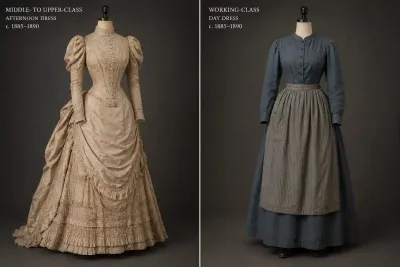
What strikes me most here is how much elaborate Victorian dress depended on labor most people didn't have access to - getting in and out of a well-structured gown often required help, which makes fashionable dress itself a quiet class marker on top of the fabric and trim.
The servant-labor dimension of this is significant enough that it gets its own dedicated entry - see the lady's maid and the labor of dressing for the specifics of what that daily routine actually involved. What I want to draw out here is the broader picture that fact sits inside: fashionable dress in this era wasn't simply expensive, it was structurally dependent on a household's access to servant labor, which meant even a family with enough money to buy fine fabric couldn't necessarily wear the most elaborate silhouettes without also employing the staff to get in and out of them. That's a class marker operating on a completely different axis than fabric cost - it's a marker of household labor structure, and it drew a harder line than money alone would have.
Working-class dress, unsurprisingly, diverged from fashion plates considerably, and in fairly predictable directions: simpler bodice construction with fewer boned seams (both cheaper to make and far more practical for actual physical work), skirts cut shorter and without the elaborate trained hems that would drag through a workplace floor, and a real time lag between what a fashion plate showed and what eventually filtered down into affordable, practical versions - sometimes years, by which point the fashionable silhouette had usually already moved on again. Working women also frequently altered or simplified secondhand fashionable garments themselves, adapting a hand-me-down bodice or dress for practicality rather than following the original design closely. I think the honest picture, once you put all of this together, is that "Victorian fashion" as popularly pictured - full silhouettes, elaborate trim, a lady's maid on hand - describes a fairly narrow slice of the population at any given moment, while the visual reality for most Victorian women looked considerably plainer, more practical, and further behind the fashion plates than the era's most famous portraits and museum pieces would suggest.