The 1960s
1960–1969
A decade that started in Jackie Kennedy's structured Camelot elegance and ended in Woodstock tie-dye - mod miniskirts and Space Age futurism in between.
Silhouettes
-
The Babydoll Silhouette
A high, gathered waistline sitting just under the bust with a full, swinging skirt below it - a deliberately childlike shape that made the mini even shorter without making it look overtly sexual.
-
The Hippie Silhouette
Loose, floor-grazing, and unstructured - the counterculture's answer to a decade that had spent its middle years obsessed with hemline and geometry, three years before the 1970s claims the same shape as its own.
-
The Jackie Look Silhouette
A boxy, above-the-knee skirt suit with a collarless jacket, worn with a pillbox hat and elbow-length gloves - structured elegance built for a young First Lady, not a debutante.
-
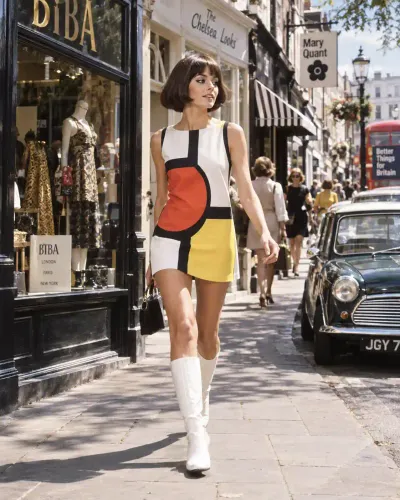
The Mod Silhouette
A short, straight, unfitted shift with no visible waist, bare legs, and flat or low-heeled shoes - the shape that made the Jackie-era suit look like it belonged to an older generation almost overnight.
-
The Space Age Silhouette
Stark white, geometric cutouts, flat-heeled go-go boots, and stiff synthetic fabrics that held their own shape independent of the body underneath - fashion imagining what a woman on the moon might actually wear.
Designers
-
André Courrèges
The couturier whose 1964 'Moon Girl' collection gave Space Age fashion its clearest visual manifesto - white, geometric, and built from fabric that held its own shape.
-
Emanuel Ungaro
A French designer trained under Balenciaga and Courrèges, who took the decade's sharp geometric tailoring and softened its edges with sensuous fabric and draping rather than abandoning its structure.
-
Emilio Pucci
The Italian designer whose bold, swirling, color-saturated prints became so specifically his own that 'a Pucci' still means a print, not a silhouette - jet-set glamour built almost entirely out of pattern.
-
Jean Muir
A British designer known for a quiet mastery of jersey and suede that stood apart from the decade's louder geometric and psychedelic instincts almost entirely on purpose.
-
John Bates
The British designer behind the Jean Varon label, best known for dressing Diana Rigg's Emma Peel in *The Avengers* - cut-out details and PVC trim applied to genuinely wearable, mass-producible mod tailoring.
-
Mary Quant
The Chelsea boutique owner most closely credited with popularizing the miniskirt - and, more importantly, with a whole retail model built around selling fast, cheap, and young rather than made-to-measure.
-
Ossie Clark
A Chelsea-scene British designer whose flowing, body-conscious cuts - made in close partnership with textile designer Celia Birtwell's prints - carried the mod era's confidence into a softer, more romantic register.
-
Pierre Cardin
Courrèges's Space Age counterpart, pushed further into genuinely unisex, helmet-and-jumpsuit futurism - and one of the first couturiers to treat licensing as a real business, not a side hustle.
-
Rudi Gernreich
The Austrian-American designer who used swimwear and underwear as his testing ground for the decade's most genuinely radical ideas about the body, gender, and what clothing was even supposed to be for.
Garments
-
Culottes
A wide-legged trouser cut and seamed to fall like a skirt - genuine freedom of movement disguised, for anyone still uneasy about a woman in visible trousers, as a perfectly ordinary skirt.
-
Go-Go Boots
Flat or low-heeled boots, usually white and cut to mid-calf, that turned footwear itself into one of the decade's clearest style statements rather than a neutral finishing piece.
-
The Kaftan
A loose, floor-length robe borrowed from North African and Middle Eastern dress, adopted by the late-decade counterculture as the clearest possible rejection of the mini's tight, engineered geometry.
-
The Mini Skirt
The single garment most synonymous with the entire decade - a hemline that climbed from just above the knee to genuinely thigh-length within a couple of years, and never fully retreated afterward.
-
The Paper Dress
A genuinely wearable dress made from treated cellulose fiber, sold by mail order for a dollar twenty-five - launched as a promotional gimmick in 1966 and briefly, seriously treated as a real answer to disposable fashion.
-
The Pillbox Hat
A small, brimless, flat-topped hat worn straight on the crown of the head - the single accessory most responsible for making Jackie Kennedy's early-60s look instantly recognizable in silhouette alone.
-
The Shift Dress
A straight, unfitted dress hanging from the shoulders with no waist seam at all - the garment that made the era's simplified, dartless construction fashionable rather than merely practical.
-
The Trapeze Dress
A dress that narrows at the shoulder and widens steadily toward the hem, tracing a clean triangular shape - Yves Saint Laurent's 1958 Dior collection idea, still very much in circulation as the new decade opened.
-
The Tunic Dress
A long, straight overdress worn over trousers or leggings - a shift dress stretched out and repurposed as a top layer, right as the decade's mod simplicity started drifting toward bohemian layering.
Fabrics & Textiles
-
Acrylic and Synthetic Knit Yarns
Orlon, Courtelle, and similar acrylic fibers gave home and machine knitting a cheap, easy-care wool substitute - distinct from Crimplene's double-knit weave, and aimed squarely at the knitting needle rather than the sewing machine.
-
Crimplene and Easy-Care Synthetics
A stiff, textured polyester double-knit that held a garment's shape through the wash with no ironing required - the unglamorous fabric doing the quiet work behind the decade's simple, geometric silhouettes.
-
Op Art Prints
Stark black-and-white geometric patterns, borrowed directly from the Op Art movement's optical illusions, printed onto the era's simplest, flattest silhouettes to maximum graphic effect.
-
Paper and Disposable Fashion
A genuine novelty gimmick - non-woven, cellulose-based dresses meant to be worn a handful of times and thrown away - that briefly became a real, if short-lived, retail category in its own right.
-
Psychedelic Prints
Swirling, saturated, hand-drawn-looking patterns drawn directly from the visual language of LSD-influenced art and concert posters - the fabric identity of the counterculture's final, loosest years.
-
PVC and Vinyl
Shiny, stiff, and unmistakably synthetic - the plastic-coated fabric that let Space Age fashion look like something manufactured rather than sewn.
Construction & Fit
-
Empire Waist Construction
Raising the waistline seam to sit just under the bust rather than at the natural waist - a technique borrowed from Regency-era dressmaking and repurposed to make an already-short hemline read as playful rather than provocative.
-
Heat-Sealed and Welded Seams
A genuinely non-traditional joining method - fusing synthetic fabric panels together with heat and pressure instead of a needle and thread - that Space Age fashion needed to fully commit to its plastic, machine-made look.
-
Pantyhose and the Shortened Hemline
A single-piece garment combining underwear and stockings into one seamless layer - the unglamorous undergarment engineering that actually made the mini skirt wearable in ordinary daily life.
-
Synthetic-Blend Easy-Care Construction
Building a garment around a wash-and-wear synthetic knit meant fewer internal layers, less structural support, and almost no ironing - a quietly significant shift in how much labor a finished garment actually demanded of the woman wearing it.
-
The A-Line Cut
A pattern-cutting approach that flares gently from shoulder or bust to hem with no waist seam at all - named, quite literally, for the letter A its silhouette traces.
-
The Zip-Front Dress and Side-Zip Closures
Moving a dress's zipper from the center back to the front or side - a small placement change that meant a woman could actually get dressed and undressed without needing a second pair of hands.
-
Vinyl Boot Construction and Sole Bonding
Cementing a vinyl upper directly to a molded sole rather than stitching and welting it by hand - the manufacturing shortcut that let go-go boots be produced fast, cheap, and in genuinely mass quantity.
Culture & Context
-
Black is Beautiful and the Civil Rights Movement
A cultural and political movement that rejected white beauty standards outright - natural hair, African-inspired prints and silhouettes worn as deliberate affirmation rather than as a passing fashion trend.
-
Jackie Kennedy and the Camelot Effect
A First Lady in her early thirties, photographed constantly and dressed with real consistency, did more to define early-60s American style than any single runway collection managed to.
-
The British Invasion and Swinging London
The Beatles' 1964 arrival in America put a specific London scene - Carnaby Street, the King's Road, mod music and mod clothes together - directly in front of a mainstream US audience for the first time.
-
The Counterculture and the Hippie Movement
Anti-war protest, the rise of psychedelic drug culture, and a genuine rejection of mainstream consumer values pushed the decade's closing years toward a silhouette that looked nothing like its opening ones.
-
The Space Race and Fashion
A real, closely-followed national competition to reach the moon gave couture a genuinely new visual vocabulary to borrow from - astronaut white, helmet shapes, and synthetic materials standing in for imagined future hardware.
-
The Youthquake Movement
Vogue editor Diana Vreeland's own term for a real, measurable shift - fashion's creative center of gravity moving from established couture houses to teenagers and twenty-somethings on the street.
-
Twiggy and the Androgynous Ideal
A sixteen-year-old London model, genuinely thin and boyish rather than conventionally curvy, became the decade's most photographed face almost overnight - and reset what a fashionable body was supposed to look like.