The 1960s mid-1960s
Culottes
A wide-legged trouser cut and seamed to fall like a skirt - genuine freedom of movement disguised, for anyone still uneasy about a woman in visible trousers, as a perfectly ordinary skirt.
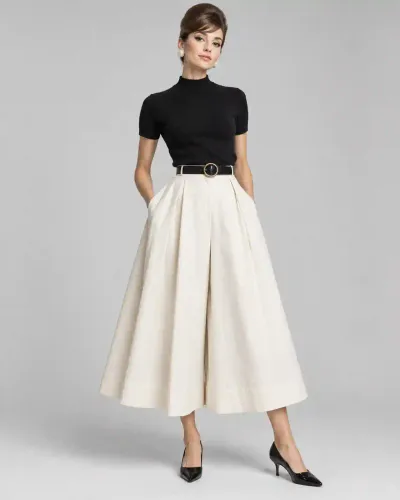
Culottes split the difference between a skirt and a pair of trousers in the most literal construction sense possible - two separate wide legs, sewn and seamed like true trousers, but cut generously enough that they hang and move like an ordinary skirt when the wearer is standing or walking. The garment itself long predates this decade, but the 1960s is where it becomes a genuine mainstream daywear staple rather than a niche practical item mostly confined to sport or riding wear.
That timing isn't a coincidence. This was still an era where trousers on women carried real social friction in a lot of everyday contexts - offices, schools, and plenty of public spaces still expected a skirt - and culottes offered actual trouser-level freedom of movement while remaining visually close enough to a skirt to sidestep a lot of that friction. A woman could cycle, climb into a low car, or simply walk with a longer, less restricted stride while still appearing, at a glance, to be wearing entirely conventional daywear.
I think culottes are worth their own entry precisely because they're a genuinely clever workaround rather than a bold style statement - unlike the mini skirt's direct confrontation with convention, culottes achieved a similar practical freedom through quiet disguise instead. That's a different, and in some ways more broadly usable, strategy for the same underlying goal the mod silhouette was chasing more loudly elsewhere: clothing built for a body that actually needed to move, not just stand and be looked at.