The 1960s mid-1960s
The Mini Skirt
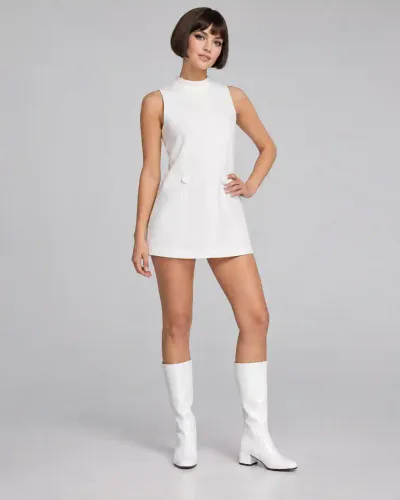
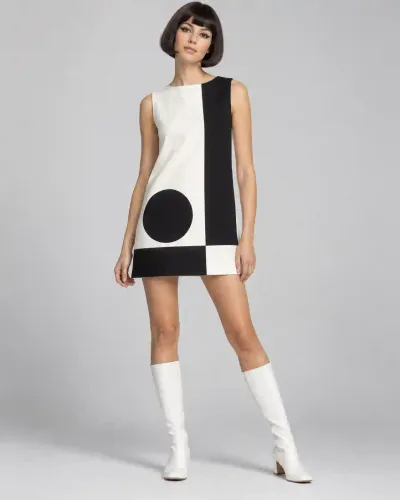
The single garment most synonymous with the entire decade - a hemline that climbed from just above the knee to thigh-length within a couple of years, and never fully retreated afterwards.
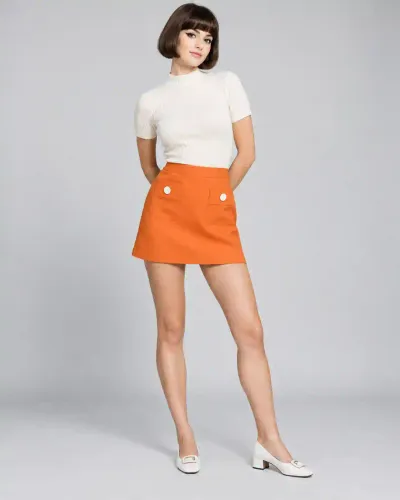
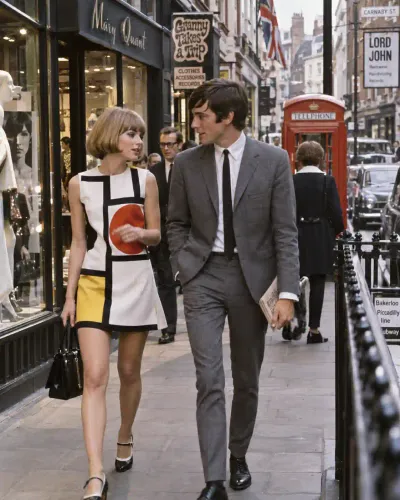
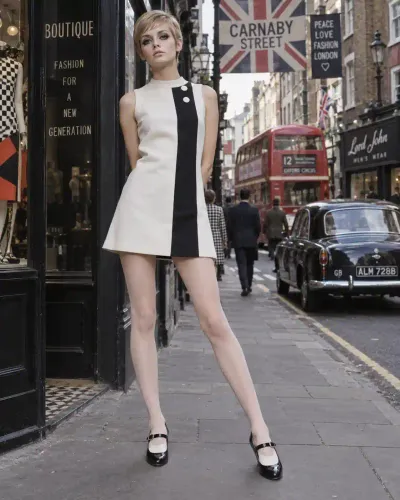
Ask most people to name one thing about 1960s fashion and this is what they'll say, which makes it a slightly strange entry to write. As a garment there's very little to reveal: it's a skirt, or a dress, cut well above the knee. What's more interesting than the length is the argument over where it came from, because the honest answer is that nobody can prove it.
The two usual claimants are Mary Quant and André Courrèges. Courrèges, who had spent a decade with Balenciaga before opening his own house in 1961, made his name with a spring 1964 collection that the Museum at FIT says "created a sensation", and he claimed outright to have invented the mini. The V&A's Courrèges ensemble from 1965 shows what his version looked like: a short, sleeveless, triangular dress in heavy cream worsted, trimmed in blue, under a matching double-breasted coat - a couture design that happens to be short, built as precisely as architecture. Quant's side of the story is the opposite. Bazaar had been selling short tunic dresses and brightly coloured tights to young Chelsea customers since the late 1950s, and her line on the question, as FIT quotes it, was: "It wasn't me or Courrèges - it was the girls in the street." FIT comes down on her side, saying she preceded him. The V&A, which mounted her 2019 retrospective, is more careful: there is "no conclusive evidence" about who first took hemlines that far above the knee, and Courrèges is "another possibility".
There's also a third name that gets left out. Marit Allen, who edited Vogue's "Young Idea" pages from 1964, insisted that the real inventor was John Bates, who designed for the wholesale label Jean Varon. The V&A has one of her Bates dresses, catalogued as 1966 and also as 1966-68, a sleeveless fluorescent lime viscose-and-nylon micro-mini bound in hot pink at every edge, just 83 cm long. So the claims come from a London boutique, a Paris couture house and a wholesale label all at once, which tells you more than any single answer would: the length was arriving from several directions in the same two or three years.
How fast did it move? When Jean Shrimpton arrived at Derby Day at Flemington in Melbourne in 1965 in a white dress four or five inches above the knee (accounts differ), with no hat, no gloves and no stockings, she knocked the winning horse off the newspaper front pages. A year later The Age reported that she "would have passed unnoticed in the crowd this year." Barbara Hulanicki of Biba recalled a 1966 shipment of jersey skirts "only 10 inches long" that she was sure would bankrupt her; instead "that little fluted skirt walked out on customers as fast as we could get it onto the hatstands." Twiggy, the V&A notes, helped turn super-short hemlines into an international trend.
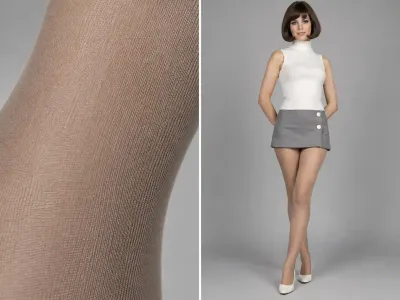
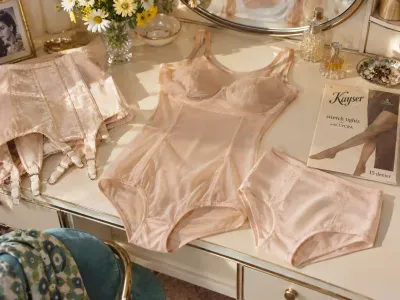
What earns the mini its place isn't the length alone, though. A hemline that short doesn't work with suspender belts and stocking tops, so it forced a change underneath: tights and pantyhose in place of stockings, and lighter shaping or none at all in place of the girdle. It also outlasted the industry's attempt to replace it - the 1970 midi was meant to be its successor, and it didn't stick.
Sources
- Introducing Mary Quant - V&A
- André Courrèges (1923 - 2016), biography - The Museum at FIT
- Coat and dress ensemble, André Courrèges, 1965 - V&A Collections
- Mini-dress worn by Marit Allen, John Bates for Jean Varon, 1966-68 - V&A Collections
- Mini-dress, Biba, 1967 - V&A Collections
- Sheena McKenzie, "Melbourne Cup: Jean Shrimpton's legs that stopped a nation" - CNN, 2012