The 1960s mid-1960s
The Mondrian Dress
Yves Saint Laurent's autumn/winter 1965 jersey shift dresses, blocked in primary colours and black grid lines after the painter Piet Mondrian - one of the most copied dresses of the decade, and a masterclass in hiding construction inside a design.
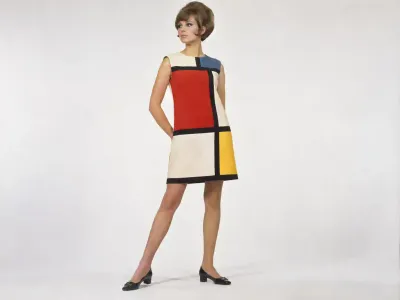
Some dresses are so recognisable they become shorthand for a whole decade, and this is one of them. In his autumn/winter 1965 collection, Yves Saint Laurent showed a group of simple, sleeveless shift dresses blocked out in white, red, yellow, and blue, divided by thick black lines - a direct homage to the paintings of the Dutch artist Piet Mondrian. The dresses were an instant sensation.
The shape was the classic mid-1960s shift: straight, knee-length, sleeveless, with a simple round neck and almost no visible shaping. That was what made it work. Mondrian's paintings are flat, geometric compositions, and a flat, geometric dress was the perfect surface to put them on. The body wasn't emphasised - the dress was treated like a canvas.
The clever part is the construction. A shift still has to fit a body with a bust, waist, and hips, and a painting doesn't have curves. Saint Laurent's dresses were made in wool jersey, pieced together from separate coloured sections rather than printed, and the shaping seams were hidden inside the black lines of the grid. So what looks like a painted design is actually a carefully engineered pattern, with the fitting built into the artwork. I think that's a brilliant piece of dressmaking, and it's worth studying if you sew: the design looks effortless precisely because all the work is concealed.
The Mondrian dress appeared on the cover of French Vogue in September 1965, and it was copied almost immediately. Ready-to-wear manufacturers, especially in the United States, produced cheap versions in huge numbers, and home sewists made their own, so the colour-block look spread far beyond couture. It fitted perfectly with the decade's fascination with modern art - it arrived in the same moment as Op Art prints and Pop Art - and with the youthful, graphic look of mod fashion. Saint Laurent went on to borrow from Pop Art and other artists in later collections, and he's covered further in the 1970s section. For me, the Mondrian dress is the clearest example of the 1960s idea that clothes could be modern art you wear - and of how much craft that idea could hide.