The 1960s mid-1960s
The Youthquake Movement
Vogue editor Diana Vreeland's own term for a real, measurable shift - fashion's creative center of gravity moving from established couture houses to teenagers and twenty-somethings on the street.
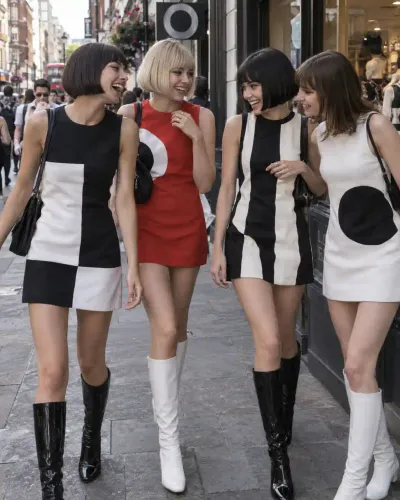
"Youthquake" is Diana Vreeland's own coinage, introduced in Vogue in 1965 to name something she and plenty of others in fashion journalism could see happening in real time: for the first time in the industry's modern history, the most genuinely influential fashion ideas weren't originating in established Paris or New York couture houses and trickling down to younger, cheaper imitators - they were originating with teenagers and women in their early twenties, on the street, in cities like London, and getting picked up and formalized by designers only after the fact.
Mary Quant's whole career, covered in the entry on her work, is close to the cleanest possible case study for how this actually worked in practice: she was consistently explicit that she was watching what her own young Chelsea customers were already doing to their hemlines and their styling choices, then turning that into formalized ready-to-wear rather than dictating a look from above and waiting for it to be adopted. The mod silhouette generally follows this same bottom-up pattern - a look assembled out of what young, working, urban women were actually wearing and doing to their own clothes, rather than handed down from a couture atelier's more traditional, older clientele.
I think the "quake" in the name is doing real work beyond just alliteration - this wasn't a gentle trend shift but something the fashion establishment experienced as genuinely destabilizing, a real inversion of who got to set taste. Age, for the first time this decade, became a source of fashion authority rather than something a designer had to overcome or compensate for with more formal training or a longer résumé, and that inversion runs underneath almost every other entry in this era's culture section - it's the underlying condition that makes the British Invasion and the later counterculture both possible as genuine fashion movements rather than isolated subcultural curiosities.