The 1960s mid-1960s
The British Invasion and Swinging London
The Beatles' 1964 arrival in America put a specific London scene - Carnaby Street, the King's Road, mod music and mod clothes together - directly in front of a mainstream US audience for the first time.
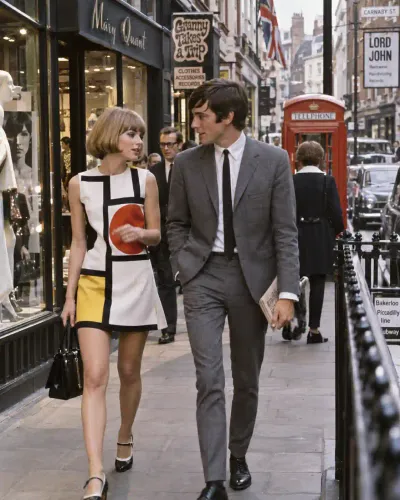
The Beatles landing at JFK Airport in February 1964 to genuinely hysterical American crowds is the cleanest single date to anchor this entry to, but the "British Invasion" as a fashion phenomenon is really about something broader that the band's arrival made suddenly, undeniably visible to an American audience: an entire London scene - centered on Carnaby Street and the King's Road, with mod music, mod hairstyles, and mod clothing all developing together as one cultural package rather than separate trends - that had already been building for a couple of years on its home turf before American television cameras caught up to it.
Mary Quant's Chelsea boutique sat close to the geographic and commercial center of this exact scene, and the mod silhouette she was selling out of Bazaar is inseparable from "Swinging London" as a whole cultural export - short, geometric, youthful clothing that read, once American magazines and television got hold of it, as the visual signature of an entire city's youth culture rather than one designer's personal aesthetic. Time magazine's April 1966 cover story literally titled "London: The Swinging City" is close to the moment this framing becomes fully official and international rather than a music-press observation.
What I think is genuinely notable about this entry, beyond the obvious transatlantic celebrity story, is how completely it reverses the direction fashion influence had traditionally flowed. Paris had been the assumed center of gravity for setting trends that eventually reached ordinary British and American consumers for the better part of a century; this moment briefly puts a specific London youth scene, driven by music and street style rather than couture ateliers, in that same influential position instead - a genuinely direct precursor to the broader youthquake reordering of who actually gets to set fashion's agenda in this decade.