The 1960s mid-1960s
PVC and Vinyl
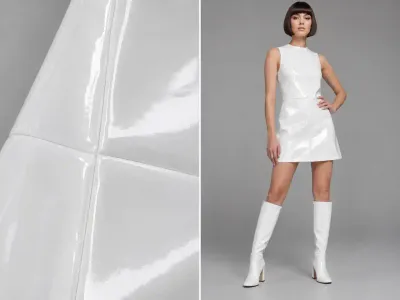
Shiny, stiff, and unmistakably synthetic - the plastic-coated fabric that let Space Age fashion look like something manufactured rather than sewn.
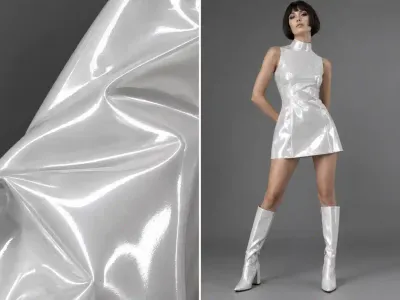
PVC - polyvinyl chloride - is older than it looks. The Museum of Design in Plastics dates its patent to 1913 and its commercial production to 1928, in Germany, and by mid-century it was the stuff of raincoats, tablecloths and protective clothing; MoDiP's list of its uses runs from firefighters to astronauts. "Vinyl" is the everyday name for the same family of plastics. In clothing it usually comes one of two ways: as a coating on a woven or knitted backing, which is what most "wet look" fabric is, or as a free-standing film, clear or coloured. To make it soft enough to wear, it's loaded with plasticisers, usually phthalates.
As a fabric it's the opposite of everything a dressmaker normally prizes. It doesn't breathe, it doesn't drape, it can't be pressed with an iron, and every pin and unpicked stitch leaves a hole for good. Those were exactly the qualities the Space Age silhouette and London's boutiques wanted, because PVC looked manufactured. The starts came close together. The V&A credits John Bates, designing as Jean Varon, with bringing plastic garments into high fashion as early as 1962, yet its introduction to Mary Quant calls her "the first designer to use PVC". Both claims can't be strictly true, and it's safer to say the two were among the first. Quant showed her "Wet Collection" in Paris in 1963, and her beige "rainsmock" of about 1964 is the early, practical version: PVC outside, black and white checked cotton inside, and six buttons down the back, so that its owner was often told she had it on backwards.
The more fashionable PVC got, the less it pretended to be rainwear. Bates made a white gabardine mini-dress and coat for the journalist Marit Allen's wedding on 10 June 1966, with a deep stand-up collar and lapels in silvered PVC - the V&A's catalogue describes a metallic polyester film applied over a blue PVC ground. In New York, the boutique Paraphernalia, founded in 1965, sold vinyl as frank fun. The Museum at FIT has a turquoise vinyl A-line mini from it with a pointed scalloped hem, and a 1965 evening shift by Joel Schumacher made of black and white vinyl squares like a racing flag, hung from straps of rhinestones. FIT calls Paraphernalia's stock an early kind of "fast fashion," youthful and disposable - the same throwaway logic as the paper dress. In California, Rudi Gernreich was setting vinyl into knitwear: his patchwork swimsuit of about 1963 for Harmon Knitwear combines wool, spandex, elastic and vinyl.
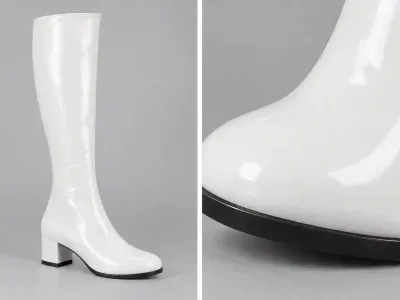
Sewing it was the sticking point, literally - Quant found that PVC clung to the machine foot or tore along the needle holes, which is why welded seams mattered so much, and why so many PVC garments are simple shapes closed with zips and snaps. Boots took to it more easily: Quant's 1967 Quant Afoot range used clear PVC over a coloured jersey lining, and Pierre Cardin made black PVC boots that reach the thigh. The boot story has its own entry on how plastic boots were moulded.
What nobody planned for was the aging. The plasticiser that keeps PVC supple slowly migrates to the surface, so old PVC turns sticky; MoDiP's guide for curators warns that dust and wrapping paper cling to it, and recommends silicone release paper and cool storage. Clear PVC yellows, too - the Warwickshire Museum's pair of 1967 Quant boots, clear over white jersey when new, have gone yellow with time. A fabric chosen to look like the future has turned out to be one of the hardest of the decade to keep, which makes the survivors far more precious than their prices ever suggested. Plastic's next fashion turn, in the 1980s, was smaller and cheaper still: jelly shoes and rubber bracelets. In the 1990s it went to the clubs.
Sources
- PVC (polyvinyl chloride) - Curator's Guide to Synthetic Garments, Museum of Design in Plastics (MoDiP)
- "Introducing Mary Quant" - V&A
- Raincoat ('rainsmock'), beige PVC, Mary Quant, ca. 1964 - V&A Collections
- Wedding ensemble, white cotton gabardine and silvered PVC, John Bates for Jean Varon, 1966 - V&A Collections
- Dress, turquoise vinyl, Paraphernalia, 1965-1968 (2008.83.7) - The Museum at FIT
- Evening dress, vinyl and rhinestones, Joel Schumacher for Paraphernalia, 1965 (2000.8.1) - The Museum at FIT
- "1922-1985 - Rudi Gernreich" - Fashion History Timeline, Fashion Institute of Technology
- Warwickshire in 100 Objects: Mary Quant Boots - Warwickshire Museum Service (Our Warwickshire)