The 1960s late 1960s
Psychedelic Prints
Swirling, saturated, hand-drawn-looking patterns drawn directly from the visual language of LSD-influenced art and concert posters - the fabric identity of the counterculture's final, loosest years.
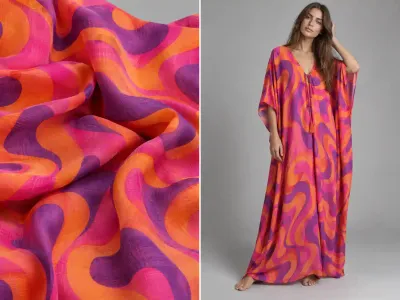
Where Op Art prints a couple of years earlier are crisp, hard-edged, and black-and-white, psychedelic prints work from close to the opposite visual instinct: swirling, organic, hand-drawn-looking shapes in loud, often clashing saturated color - hot pink against orange, acid green against purple - patterns that read as fluid and unstable rather than sharp and optical. The direct source is the visual culture growing up around LSD use and the San Francisco music scene, particularly the hand-lettered, melting-typography concert posters advertising shows at venues like the Fillmore, whose visual grammar of swirling color and warped lettering carried over onto fabric almost unchanged.
Applied to fabric, these prints found their natural home on the loose, unstructured garments of the hippie silhouette - a flowing kaftan, a peasant blouse, a maxi skirt - for much the same structural reason Op Art needed the flat mod shift: a busy, swirling pattern needs generous, minimally-broken fabric to actually read, and loose draped garments give it that space far better than a tightly fitted one would. Emilio Pucci's contemporaneous prints share some surface similarity in their bold color and swirl, but come from a genuinely different, more aristocratic lineage - worth keeping distinct from this specifically countercultural visual language even when the two get lumped together in casual retrospectives.
I'd place psychedelic prints as the clearest possible fabric-level marker of how far this decade travels between its opening and closing years, tied directly to the broader counterculture and hippie movement that produced them. A wardrobe built around the crisp, structured Jackie look in 1960 and one built around a swirling, LSD-poster-inspired print on a loose kaftan in 1969 look like they belong to entirely different centuries of fashion, not just opposite ends of the same ten years - which is really the whole argument for treating this decade as two distinct halves rather than one continuous "sixties look."