The 1960s throughout the 1960s
Marimekko and Scandinavian Prints
Huge, flat, joyful prints on plain cotton from a Finnish textile company - Unikko's giant poppies, bold stripes - worn as simple, unfitted dresses and famously bought by Jacqueline Kennedy in 1960.
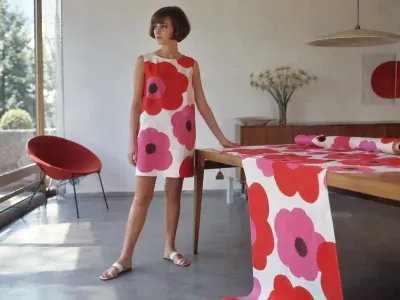
Marimekko prints are some of the most recognisable textiles of the twentieth century, and I think they're easy to underestimate because they look so simple. Big, flat shapes, bright colours, plain cotton - but in the early 1960s, that was a genuinely radical way to think about what a dress could be.
Marimekko was founded in Finland in 1951 by Armi Ratia, as an offshoot of her husband's textile printing firm. The idea was to show off the company's printed cottons by making them into simple clothes. From the start, the company worked with young artists and designers rather than traditional textile designers, and the prints reflected that: large-scale, abstract, brightly coloured, and printed by hand on screens. Vuokko Nurmesniemi's striped designs of the 1950s, including the unisex striped Jokapoika shirt, set the tone. The most famous print of all came in 1964, when Maija Isola designed Unikko, the giant, flat poppy, reportedly in defiance of Ratia's view that Marimekko shouldn't print flowers.
The dresses themselves were just as important. They were loose, unfitted shapes - smocks, shifts, and tent dresses - with very little structure, so the print could be seen whole. There were no waists, darts, or boning to fight. That was a real change from the tightly fitted clothes of the 1950s, and it anticipated the easy shift dress that became the basic garment of the decade. Many women also bought the fabric by the metre to make their own clothes and curtains.
Marimekko arrived in the United States through Design Research, an influential modern design shop in Cambridge, Massachusetts, which began selling it in 1959. The big boost came in 1960, when Jacqueline Kennedy bought several Marimekko dresses there during her husband's presidential campaign and wore one on the cover of Sports Illustrated - a pointed choice at a moment when she was being criticised for spending too much on Paris couture. I like Marimekko as a counterweight to the other 1960s print stories on this site. Op Art was about optical tricks and psychedelia about swirling excess; Marimekko was about clarity and cheerfulness, a big, simple shape on a simple dress. It still looks modern today.