The 1960s mid-1960s
Op Art Prints
Stark black-and-white geometric patterns, borrowed directly from the Op Art movement's optical illusions, printed onto the era's simplest, flattest silhouettes to maximum graphic effect.
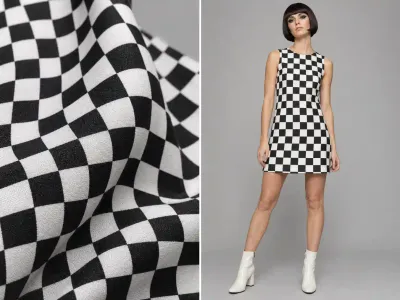
Op Art - short for Optical Art, a fine-art movement built around geometric patterns that trick the eye into perceiving movement, depth, or vibration on a flat surface, with Bridget Riley as its most recognized name - crossed over into fashion print with unusual speed and directness for this decade. Where a lot of fashion borrows loosely from a broader art-world "mood," Op Art prints on 1960s fabric are often close to literal reproductions of the movement's actual techniques: sharp black-and-white checkerboards, concentric circles, wavy parallel lines, all designed to create the same disorienting optical vibration on a dress that Riley's paintings created on a gallery wall.
The pairing with this decade's flattest, simplest silhouettes wasn't incidental - it was close to necessary. A busy optical pattern like this needs a large, uninterrupted, minimally-seamed surface to actually read correctly; cut into a fitted, heavily-darted 1950s-style garment with lots of seaming breaking up the fabric, the illusion would fragment and lose its effect almost entirely. The plain shift dress and the broader mod silhouette, with their large flat panels and minimal internal seaming, were close to the ideal canvas for exactly this kind of print, which is part of why the two trends peak in almost exactly the same narrow window of years.
I think Op Art prints are worth their own entry rather than folding into "1960s geometric prints" generally because the borrowing really is that direct and traceable to a specific, named art movement happening in galleries at the same moment - a genuinely rare case of high art and mass-market fashion moving at close to the same speed, rather than fashion absorbing an art-world idea a decade or more after the fact the way it often does. By 1967, as the hippie silhouette and looser draping take over the leading edge of fashion, this crisp, optical, black-and-white sensibility recedes almost as fast as it arrived, replaced by psychedelic prints working from a completely different visual logic.