The 1960s early-to-mid 1960s
The Shift Dress
A straight, unfitted dress hanging from the shoulders with no waist seam at all - the garment that made the era's simplified, dartless construction fashionable rather than merely practical.
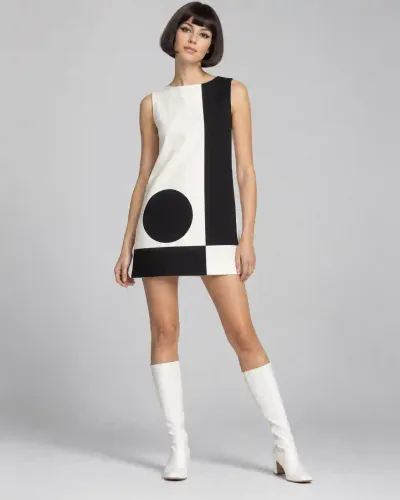
The shift dress is, structurally, about as plain as a dress can get: a straight or very slightly A-line cut hanging from the shoulders with no defined waist seam anywhere, front and back panels joined at the sides with minimal shaping. That simplicity is exactly what makes it worth its own entry rather than treating it as a footnote to the mini skirt or the mod silhouette generally - it's arguably the single garment most responsible for making unfitted, dartless construction feel like a genuine fashion choice rather than a budget compromise.
That distinction actually matters historically. Simple, straight-cut dresses had existed for decades as an economical option, but they'd generally read as plain rather than stylish - the interesting, fashionable silhouette was assumed to be the fitted, waist-defined one going back through the 1950s and well before it. The shift dress flips that assumption for the first time in this era: worn short, in a bold geometric or solid color, by a young woman with the confidence to wear a shape with no waist definition at all, it reads as current and youthful specifically because it isn't trying to shape the body underneath it. Mary Quant built much of her early-to-mid-decade output around exactly this shape, precisely because it was fast and cheap to cut and sew at scale.
I think the shift's real legacy is less about any single decade and more about permanently normalizing the idea that a dress doesn't need a waist seam to be considered fashionable - a genuinely durable shift in what "a nice dress" was allowed to mean, one that outlasts the specific mod context it emerged from by decades. It's a quietly foundational garment for exactly that reason, even though it looks, on its face, like one of the least eventful pieces in this whole era's wardrobe.