The 1950s late 1950s (introduced 1958)
The Trapeze Line
A triangular, unfitted shape flaring from a narrow shoulder to a wide hem - Yves Saint Laurent's first collection as head of Dior, and the silhouette that bridges the decade's tailored shapes into the looser 1960s.
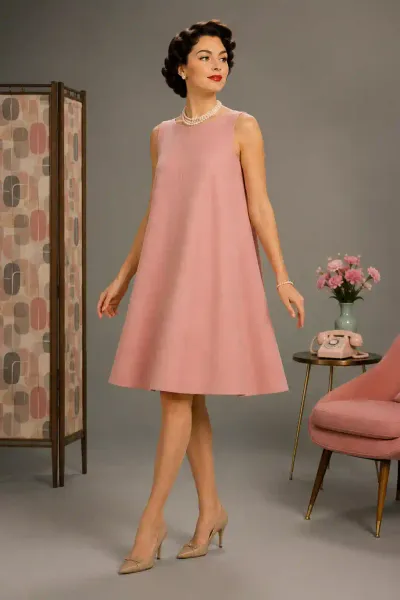
It's a neat bit of fashion-history timing that the trapeze line comes from the same house that opened the decade with the New Look - Saint Laurent inherited Dior in 1957 and immediately pushed the silhouette toward something looser and younger.
Saint Laurent was only twenty-one when Dior died suddenly in October 1957, and his appointment as the house's new head designer was itself major news - a very young, largely untested talent inheriting arguably the most influential name in fashion. His debut collection in January 1958 needed to do two things at once: prove he could carry the house forward, and say something distinctly his own rather than simply continuing Dior's established line. The trapeze line did both - narrow at the shoulder, widening in a clean triangular sweep down to a hem that swung freely with movement, no waist seam pulling the eye back to the cinched-waist orthodoxy the house itself had spent a decade establishing. It was received warmly, which is worth noting given how roughly the press had treated Balenciaga and Dior's own sack silhouette from the previous year - a young designer picking up the same core idea and softening its edges into something more clearly wearable seems to have made all the difference in how it landed.
The line directly toward the shift dress is about as clean as fashion-history throughlines get: unfitted, waist-skipping silhouettes go from press controversy in 1957, to an haute couture debut success in 1958, to genuinely mainstream ready-to-wear daywear within just a few more years, as the shift dress becomes one of the defining garments of the early-to-mid 1960s. I think the trapeze line deserves real credit as the hinge point in that sequence - the sack dress proved the idea could exist and survive; the trapeze line is what proved it could actually be beloved, at the very same house, in barely a year's turnaround.