The 1950s early 1950s (introduced 1947)
The New Look
Christian Dior's 1947 debut silhouette - a cinched waist over a wide, fabric-heavy skirt - that set the tone for the first half of the decade before shapes like the wiggle dress took over.
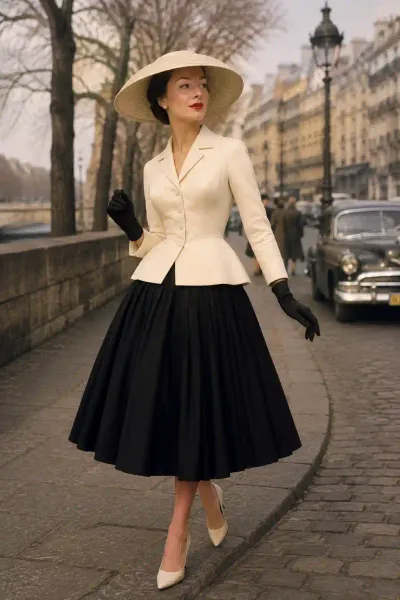
The New Look is worth separating out from the Christian Dior entry. That one is about the man and the house; this one is about a shape, and the shape had a longer life than any single collection. For the first half of the 1950s it is what everything else is either copying or arguing with.
Dior showed his first collection at 30 avenue Montaigne on 12 February 1947. He called it two lines, Corolle and En Huit (figure-of-eight), and Carmel Snow of Harper's Bazaar christened the whole thing on the spot as the "New Look". None of the parts was new on its own. Paris had shown a nipped waist and fuller skirt in 1939 before the war shelved it, and the postwar softening had been rounding shoulders and lengthening hems since 1945. What was new was the commitment: sloping shoulders, a hand-span waist, padded hips and a skirt that stood away from the legs, all pushed to the extreme at once.
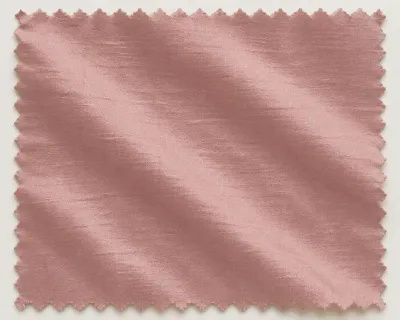
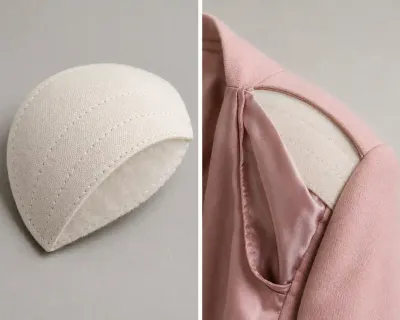
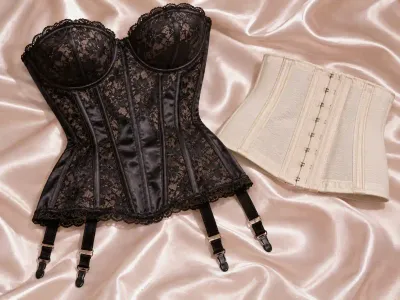
The V&A's objects show how much building that took. The Bar suit, given by the house itself in 1960 (and possibly a remake made around 1955), has a hip-length jacket of natural silk tussore with padded hips, over a fully pleated black wool crêpe skirt mounted on a stiffened taffeta petticoat, with a quilted silk waistband shaped to throw the skirt out from the hips. A grey wool flannel jacket of 1947-48 gets its hourglass from wads of padding and horsehair around the front of the hips. The black wool "Maxim's" cocktail dress from the first collection squeezes the waist with a cummerbund-style lower bodice and holds the skirt out on an attached petticoat of heavy ribbed silk. Harper's Bazaar printed detailed line drawings of the construction, which tells you that readers wanted to know how it was done.
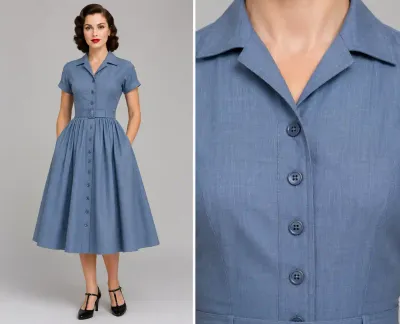
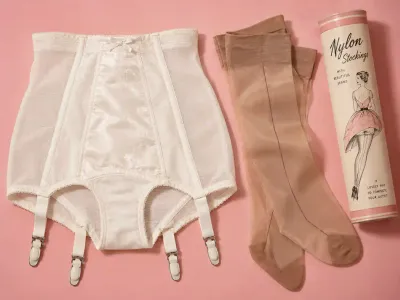
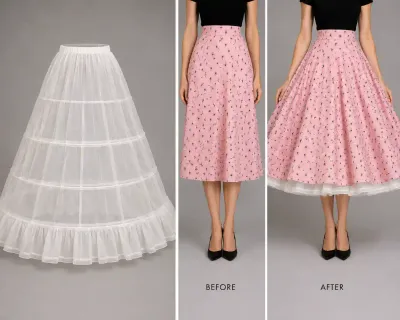
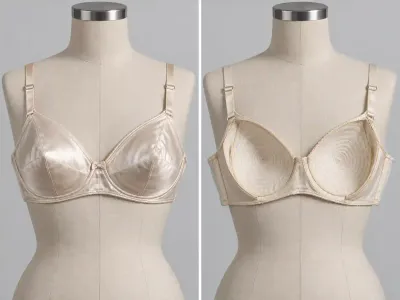
The fabric was what people noticed. The V&A gives typical figures of 15 metres for a woollen day dress and 25 for a short taffeta evening dress. In Britain, where a Utility dress was held to about 1.8 metres and clothes were still on coupons, that read as a provocation, and the Bar suit record notes the "official complaints"; Mass Observation's diarists argued about it from September 1947, as the postwar rationing entry covers. Not every New Look dress was a feat of engineering, though. The V&A's "Green" day dress from the En Huit line is unlined spotted silk foulard, its volume coming from a softly gathered, draped skirt, with Magyar sleeves for ease of movement. That is the version a home dressmaker could actually make: the line without the armour, held out by a net petticoat and an everyday girdle rather than a built-in corselet.
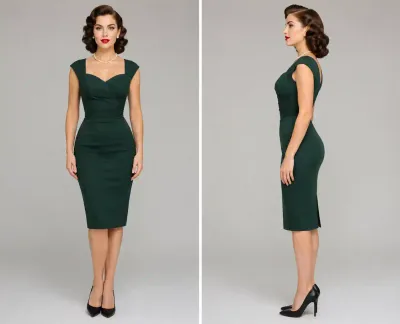
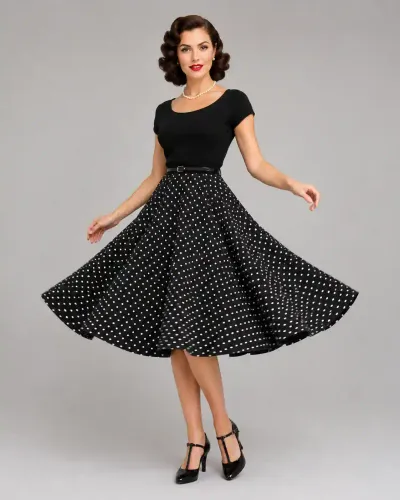
The shape didn't stay fixed, and Dior was the first to move it. By spring 1950 his Verticale line included "Nonette", a raglan-sleeved grey worsted bodice over a separate pencil skirt, which a house model wore at Dior's first London show at the Savoy that April. The Museum at FIT's timeline still counts the New Look as the leading silhouette until the mid-1950s, but from about 1950 the full skirt and the narrow one run side by side. The full version settled into everyday wear as the shirtwaist dress and the circle skirt; the narrow one became the wiggle dress, which keeps the cinched waist and drops all the volume. I find that arc more interesting than the famous debut: one idea about the waist, worked out in two opposite directions over seven or eight years, until Dior's own H-line of 1954 loosened the waist itself.
Sources
- 'Bar' skirt suit, Christian Dior, La Ligne Corolle, 1947 (possibly made 1955) (T.376&A-1960) - V&A Collections
- 'Maxim's' cocktail ensemble, Christian Dior, Corolle line, spring/summer 1947 - V&A Collections
- 'Green' day dress, Christian Dior, En Huit line, spring/summer 1947 - V&A Collections
- Jacket, wool flannel, Christian Dior, Paris, 1947-1948 - V&A Collections
- 'Nonette' skirt suit, Christian Dior, Verticale line, spring/summer 1950 - V&A Collections
- "What was the big fashion controversy of 1947?" - Mass Observation Archive
- Karina Reddy, "1950-1959" (decade overview) - Fashion History Timeline, Fashion Institute of Technology