The 1950s 1950s
The Everyday Girdle
The latex, power-net and elastic girdles - roll-ons, panty girdles and long-leg girdles, with suspenders for stockings - that almost every 1950s woman wore every day, slim or not, and that teenage girls were fitted for as a rite of passage.
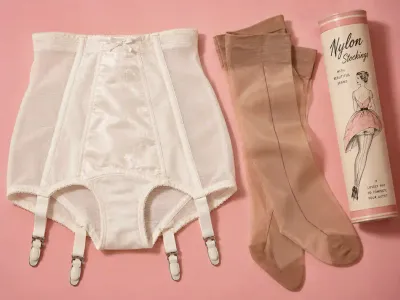
The waspie and the Merry Widow are the dramatic foundation garments of the 1950s - for evening dresses, weddings, and special occasions. This entry is about the ordinary one: the girdle, worn every day by an enormous number of women, under everything from office suits to housedresses. It's so central to the decade's look that I'm surprised how rarely it gets discussed.
A girdle was a close-fitting elasticated garment covering the lower torso, from the waist to the hips or thighs, designed to smooth and flatten the stomach and hips. It came in several forms. The roll-on was a simple tube of elastic fabric pulled on over the hips. The panty girdle had a crotch, like very firm knickers, and often extended partway down the thigh; long-leg girdles went almost to the knee. Most had suspenders (garters) attached to hold up stockings, which were still worn by respectable women every day. Materials had improved after the wartime rubber shortage: elastic power-net, satin panels, nylon and, from the International Latex Corporation's Playtex brand, girdles moulded from latex, famously sold rolled up in slim tubes. At the very end of the decade, DuPont's new Lycra fibre offered lighter control.
Why did so many women wear one? Partly because the fashionable shapes demanded it. A wiggle dress or a pencil skirt showed every line of the hips and stomach, and a girdle gave the smooth, firm outline these clothes were designed around. Even under full skirts, the look depended on a small, controlled waist and flat front. But it was also about propriety. Going without a girdle could be seen as sloppy or even slightly improper, a sign of letting yourself go, and conformity in dress ran deep. Slim women wore girdles too.
It even had a place in growing up. For many teenage girls, being fitted for a first girdle, like a first bra or first pair of stockings, was a marker of becoming a young woman, and manufacturers targeted the teen market with lighter "junior" girdles. Many women found them uncomfortable, hot, and restrictive, and that discomfort is a big part of why the girdle collapsed so quickly in the following decade. But for most of the 1950s, the smooth, controlled 1950s figure you see in photographs was built, every morning, by the girdle.