The 1950s 1950s
Crinolines and Petticoats
The stiffened, layered underskirts that gave full 1950s skirts their volume and swing.
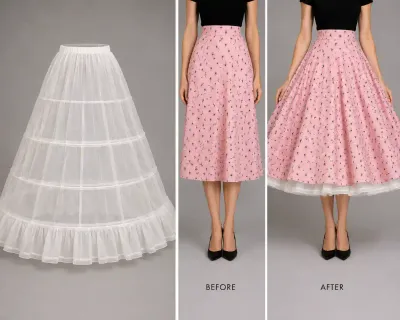
None of the decade's full-skirted silhouettes work without what's underneath them - layers of stiffened net or starched cotton doing the actual work of holding a skirt out. It's a good reminder that a lot of 1950s "silhouette" is really an engineering problem.
There's real variety hiding under the single word "petticoat" in this decade. A basic layered net petticoat, stacked two or three deep, could deliver a modest amount of fullness for everyday wear at low cost and low bulk. For real occasion-wear volume, a hoop petticoat - a lightweight circular framework, usually plastic or thin wire hoops sewn into fabric channels, doing structurally the same job as a Victorian cage crinoline in miniature - could hold a skirt out dramatically without needing many layers of net stacked on top of it. And starched or "crinoline" petticoats, made from stiffened cotton net (the fabric itself is often literally called "crinoline" in period sewing terminology, distinct from the Victorian garment), split the difference: real body and rustle without the hoop's more rigid structure, though they needed periodic re-starching or a trip through a sugar-water stiffening solution to hold their crispness through repeated wear and washing.
The comparison to the Victorian cage crinoline is genuinely worth drawing out directly, because the engineering logic is almost identical even though the two garments arrive a century apart for completely different reasons. Both are, at bottom, a lightweight internal framework solving the same basic problem - how to hold a large quantity of skirt fabric away from the body without needing the wearer's own legs and stacked petticoats to do all the work. The real difference is what's driving the fullness: the Victorian crinoline was replacing a genuinely burdensome number of petticoats a fashionable silhouette already demanded, while the 1950s version is reviving fullness on purpose after nearly two decades of wartime-driven slimness, treating volume itself as the whole point rather than a structural inheritance the fashion had already settled into. It's a nice reminder that a specific engineering solution - hoops and stiffened layers holding a skirt out - can recur across totally different eras whenever fashion independently arrives at wanting the same basic silhouette problem solved.