The Victorian Era Early Victorian / Romantic (1837–1850)
Early Victorian / Romantic
A natural waistline drifting into a dropped shoulder, with wide skirts still supported by layered petticoats rather than a cage.
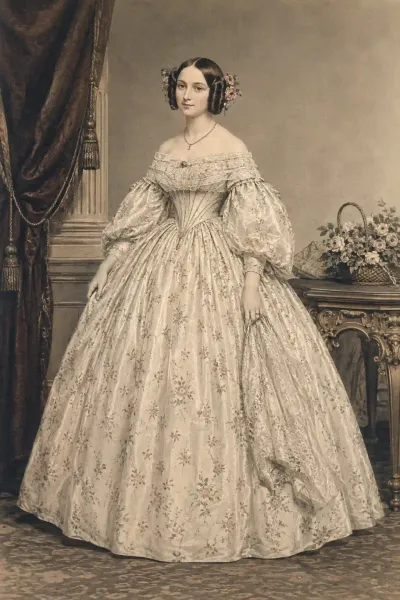
This is the gentlest silhouette of the whole era - soft, sloping shoulders and a skirt that's full but not yet the bell shape the crinoline would bring. It's easy to skip past on the way to the more dramatic decades, but I think it deserves attention on its own terms.
Structurally, this is a silhouette built almost entirely from soft engineering rather than hard architecture. The sleeve is set low, off the natural shoulder point, which is what gives the era its characteristic sloped, almost apologetic shoulder line - a look achieved with small sleeve puffs or gathers (gigot sleeves collapse out of fashion by the early 1840s, replaced by narrower, more fitted forms) and internal padding rather than any rigid understructure. The bodice comes to a long, pointed front - often boned lightly, but nothing like the rigid corsetry that shows up later in the century - and the waistline sits at or close to the natural waist throughout, which is part of why this decade reads as comparatively gentle next to what follows. All that fullness in the skirt is doing its work through sheer quantity of fabric and petticoats: three, four, sometimes more layers, occasionally corded or stiffened at the hem, stacked to hold a bell-ish shape without a single piece of boning or steel anywhere in the skirt itself. It's laborious in its own way, just laborious through bulk rather than structure.
I think of this as the last silhouette that's genuinely pre-industrial in spirit, even though it's not pre-industrial in date. Everything about it - the hand-finished seams, the soft shaping, the sheer petticoat count - assumes a dressmaker working by hand, because that's exactly what's happening. Singer and others don't get a reliable commercial sewing machine onto the market until the early-to-mid 1850s, just past this period's own end, and even then adoption is gradual; a middle-class woman having a dress made in, say, 1842 is getting it made the way dresses had been made for a generation before her. That's worth sitting with, because it means the "Romantic" label isn't just describing puffed sleeves and a soft shoulder - it's describing an entire mode of production that's about to change permanently, one this sub-period is the last full expression of.
There's also a cultural read here I don't want to skip past: this softness is doing ideological work, not just aesthetic work. Victoria's own accession in 1837 lands right at the start of this silhouette's run, and the sloped-shoulder, small-waisted, modestly-covered shape it favors maps neatly onto the era's emerging ideal of domestic, decorative femininity - a very different visual argument than the engineered, almost architectural bodies the crinoline and bustle silhouettes will go on to make later in the century. It's the silhouette equivalent of a hushed voice, and I don't think that's an accident.