The Victorian Era Crinoline era onward (from the late 1850s)
Hand-Sewing to Machine-Sewing
The domestic sewing machine's spread from the late 1850s onward is a real inflection point - construction gradually shifts from entirely hand-worked to machine-assisted across the rest of the era.
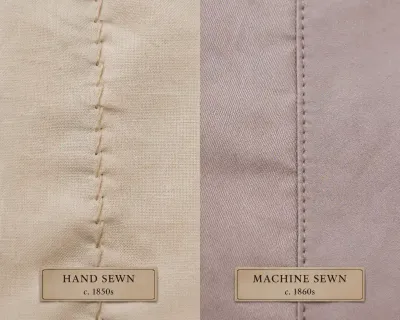
It's easy to underrate how big a shift this actually was - Singer had a commercial (industrial) machine as early as 1851, but it's specifically the 1856 domestic model, paired with an installment credit plan that let ordinary households afford one for the first time, that arrives right as the crinoline era is taking off. Construction time for a dress with that much fabric drops dramatically once machine seams start replacing hand-sewn ones.
It really wasn't an overnight, total replacement, and I think that nuance matters more than the "machines arrived" headline. Long, straight structural seams - skirt panels, bodice side seams, the long runs of stitching that hold a lined garment together - were exactly what a machine did fastest and most reliably, and dressmakers adopted machine construction for these almost immediately once a machine was available, since the time savings there were enormous and the visible quality difference was minimal. But finishing work stayed stubbornly hand-done for decades longer: buttonholes, hooks and eyes, delicate hemming on fine fabrics, and especially any gathering or shirring meant to sit softly rather than mechanically - a machine of this era produced a noticeably even, somewhat stiff line of stitching that didn't suit every application. Fine eveningwear in particular kept a good deal of hand-finishing well past mid-century simply because a client paying for the best expected hand work on the parts that showed, even if the unseen structural seams underneath were machine-sewn for speed.
The bigger shift, honestly, might be economic rather than purely technical. Singer's installment credit plan - letting a household pay for a machine over time rather than all at once - did as much to spread the machine into ordinary homes as the technology itself, and it's a genuinely early example of consumer credit being used to sell a household appliance, a sales model that shows up again and again through the rest of the century for other goods. For a dressmaker running her own business, owning a machine meant taking on more clients in the same amount of time, which changed the economics of the trade itself, not just the stitching. That's really the throughline I'd want a reader to take from this entry: the sewing machine's arrival isn't just a construction-technique footnote, it restructures who could produce fashionable dress, how fast, and at what cost, right at the exact moment the crinoline era's huge fabric consumption was making all of that more urgent than ever.