The Victorian Era Bustle era onward (1870s–1901)
Glove-Fitting Bodice Construction
The extremely close, second-skin bodice fit that defined later Victorian silhouettes, achieved through precise seaming and boning rather than the corset alone doing all the work.
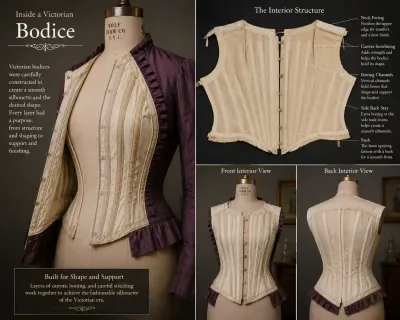
"Glove-fitting" is the period's own term for this, and it's accurate - later Victorian bodices are cut with a level of seam precision that leaves almost no ease at all, which is a real technical achievement on top of whatever the corset underneath is doing.
The seaming is where the real technical work happens. Rather than the two or three simple darts an earlier-century bodice might use to shape fabric around the bust and waist, later Victorian bodices are cut with multiple curved seams running the full length of the torso - often six, eight, or more separate pattern pieces per bodice - each one following the body's actual curve rather than compressing fullness into a single dart intake. That's a fundamentally different drafting approach: instead of flat fabric with darts taken out to fake a curve, the pattern pieces themselves are already curved, so the seam lines do continuously what a dart only does at one point. Every one of those seams typically carries its own thin bone, usually feather-boning or narrow steel by this period, sewn into a channel right along the seam allowance - which means the boning isn't a separate structural layer sitting on top of the fit, it's built directly into the same seams doing the shaping, reinforcing the exact curve the pattern already establishes rather than fighting against it.
The result is a bodice that holds its shape almost independent of the body inside it - lay one flat on a table and it still largely keeps its three-dimensional curve, which is a genuinely different category of garment from a softly draped early-Victorian bodice. I think this is worth dwelling on because it reframes what the corset is actually doing by this point in the era: it's not solely responsible for the era's smooth, close silhouette, it's working in partnership with a bodice that's independently engineered to hold the same line. Get the seaming wrong and no amount of tight lacing underneath fully compensates - which is exactly why "glove-fitting" construction commanded real skill and real prices among late-Victorian dressmakers, and why a well-made example of one, examined closely, still reads as genuinely impressive tailoring more than a century later.