The 1950s 1950s
Boned Bodices
Structural boning built into a bodice to hold its shape and support the bust without a separate corset underneath.
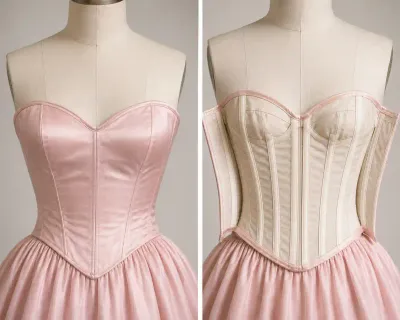
This is a lighter-touch descendant of true corsetry - boning sewn directly into the garment's own lining rather than a separate structural piece. It's exactly the kind of construction detail I find myself geeking out over more than the silhouette itself.
Channeling is really the whole trick that lets this construction work as a "lighter-touch descendant" rather than a separate garment. Rather than a standalone corset with its own fabric shell, boning here is sewn directly into narrow channels formed within the bodice's own lining or a dedicated understructure layer basted to the fashion fabric - meaning the boning is doing its structural work invisibly, sandwiched between the outer fabric a wearer sees and an inner lining she doesn't, with no separate foundation garment required underneath at all beyond ordinary lingerie. That's a genuinely different design philosophy from full corsetry: instead of one general-purpose structural garment worn under anything, each bodice gets exactly the boning it specifically needs, placed precisely where that garment's own cut requires support, and nowhere else.
Materials by this decade had moved well past whalebone - flexible spiral steel boning (a tightly coiled steel wire that bends in multiple directions rather than just one, ideal for following a curved seam) and various plastic or featherboning options were both in common use, chosen based on how much rigidity a given design actually needed. A wiggle dress bodice, for instance, generally wanted less aggressive boning than a fully strapless evening gown - enough to hold a smooth line and prevent the fabric from creasing or bagging at the waist, but not the full structural load-bearing job a strapless bodice's boning has to handle with no shoulder strap to share the work. That range, from light shaping support to genuine load-bearing structure, all falling under the same general "boned bodice" label depending on what a specific garment needed, is exactly the kind of construction nuance I think gets flattened out of most casual accounts of this decade's fashion - and exactly why I keep finding myself drawn back to it.