The 1970s 1970s
The Decline of Foundation Garments
The real construction consequence of 'natural' dressing - garments cut to be worn with minimal or no structured underpinning, a genuine break from decades of built-in boning and shaping.
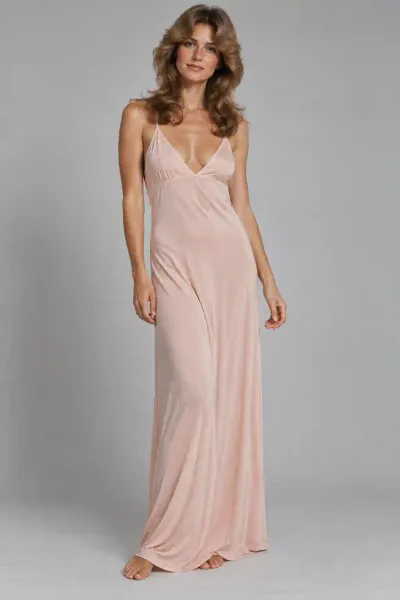
I want to separate the myth from the construction reality here, because they get conflated constantly. There was no mass bra-burning - that image comes from a single 1968 Atlantic City protest where nothing was actually set on fire, and the "burning" framing was largely a press invention. What's real, and what this entry is actually about, is a decade-long shift in how outer garments were cut to relate to the body underneath them, moving steadily away from the assumption that a woman's silhouette needed a rigid foundation doing the shaping work first.
That shift shows up directly in pattern construction. A 1950s bodice was routinely cut assuming a structured, often boned or heavily seamed bra and girdle underneath it - the outer garment's darts and seams were placed to work with that foundation, not to do the shaping alone. Through the 1970s, softer-cup and wireless bra construction (Rudi Gernreich's "No Bra Bra" for Exquisite Form in 1964 is the real technical precursor here, built from sheer stretch nylon with essentially no boning or molded cup) became mainstream rather than niche, and outer garments followed that logic outward: the halter top is the clearest case, its tie-neck and open back genuinely incompatible with a traditional structured bra, which meant the garment itself had to take over some of the support function through its own cut - a fitted, often lined bodice doing double duty as both outer layer and minimal built-in support, rather than relying on a separate foundation piece underneath.
The cultural context matters for why this happened when it did, but I don't think it's the whole story on its own - construction had to actually solve the engineering problem of a woman going without heavy structure and still having a garment that held its shape reasonably well on a moving body, and that took real pattern-drafting work, not just a change in attitude. Jersey and other stretch knits made a lot of this genuinely easier, since a knit could cling and support somewhat on its own where a rigid woven fabric couldn't. Between growing comfort with less structured underpinning (tangled up, fairly or not, with the era's women's-liberation politics) and knit fabrics actually capable of doing more of the shaping work themselves, this decade is where "built-in support" stops meaning boning sewn into a foundation garment and starts meaning something closer to what it means in ready-to-wear today.