The 1960s mid-1960s
Pantyhose and the Shortened Hemline
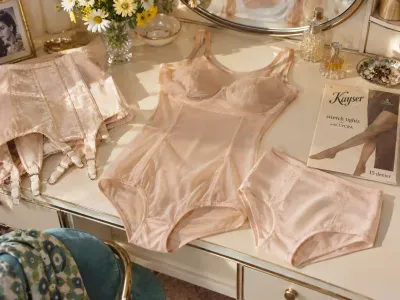
A single-piece garment combining underwear and stockings into one seamless layer - the unglamorous undergarment engineering that actually made the mini skirt wearable in ordinary daily life.
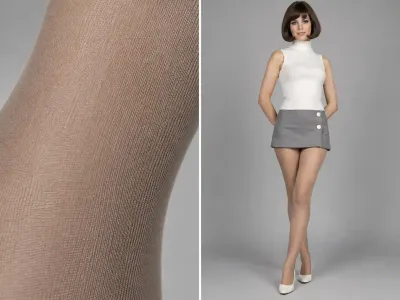
This is one of the most underrated construction stories of the decade, precisely because nobody sees it. Pantyhose - a brief and two full-length stockings knitted or joined into one garment, held up at the waist instead of by suspenders - were on sale in America by 1959. But it took the rising hemline of the mid-1960s to turn them from a novelty into something close to a necessity.
The American version has a well-documented family origin. In 1953 Allen Gant Sr., who ran Glen Raven Mills in North Carolina, was on the overnight train home from the Macy's Thanksgiving Day Parade with his pregnant wife, Ethel Boone Gant, who told him this would be her last trip until the baby came: stockings, suspenders and girdle had become too uncomfortable. Gant asked whether they could make a pair of panties and fasten the stockings to it. Ethel stitched a rough prototype, tried it on, and handed it back with "You got to figure out how to do this." With colleagues Arthur Rogers, J. O. Austin and Irvin Combs, he developed what the firm called "Panti-Legs", which reached department stores in 1959. Smithsonian's account is frank that most women weren't interested at first.
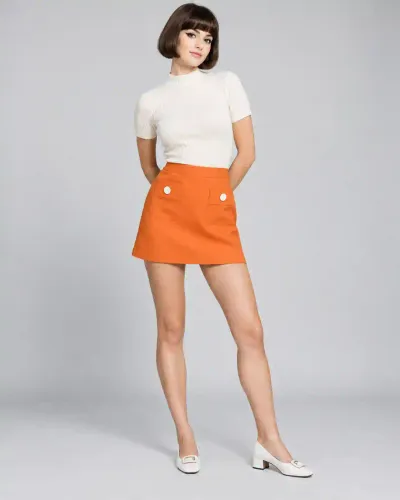
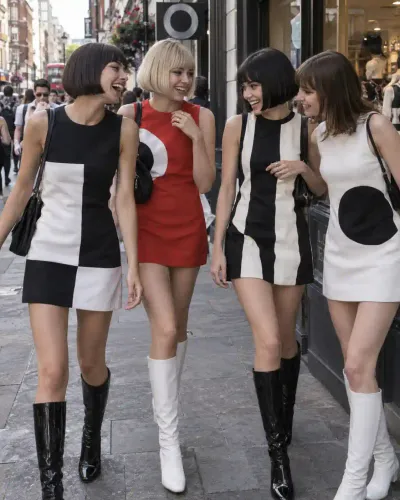
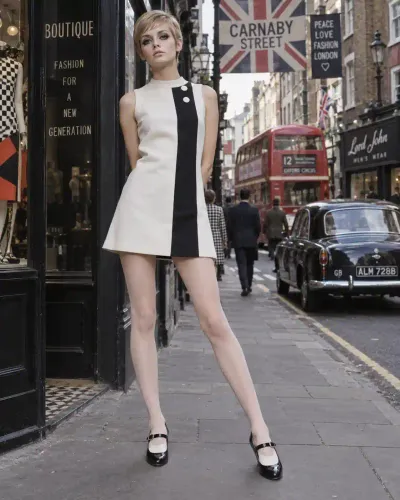
The problem they solved is a mechanical one. Stockings stopped at the upper thigh and were held up by suspenders clipped to a belt or girdle, and a knee-length skirt hid the welt, the clips and the bare band of skin above them. Shorten the skirt to a mini and all of that shows the moment you sit down, bend or climb onto a bus. Pantyhose remove the problem at its source. It was the mini that made them sell: "When Twiggy came along, you couldn't even bar the door," Allen Gant Jr. told Smithsonian. New sewing techniques and fibres such as spandex brought the price down and widened the range of sizes, and that is a large part of why the girdle disappeared so quickly - one of its main jobs had been holding stockings up.
In Britain the story ran through "tights", and through colour. The V&A has a pair of Mary Quant tights from 1963 in ginger ribbed wool or acrylic, a thick, opaque, school-and-dance-class garment that Quant turned into fashion by pairing short tunic dresses with tights in scarlet, ginger, prune and grape. The V&A notes that "warm pantyhose" had been an option in winter, but most women still preferred stockings. From about 1964 the Nylon Hosiery Company, run by the Curry family, produced Quant's hosiery, and the brothers developed a way of making long stockings that were joined together at the top - the same basic idea Ethel Gant had sewn by hand, now made by machine. Quant's range grew to new colours and patterned knits, and her 'Starkers' tights of around 1968 came in printed silver packaging with the daisy logo.
Stockings didn't vanish overnight. From 1966 Quant also sold "Hi-ball" glitter stockings in silver, gold, green, blue and red, and the V&A has a silver pair from 1967, 72 per cent metallic yarn, which their owner wore on "VERY special occasions only." But for a home dressmaker the change reached into every layer: in 1968 Simplicity sold pattern 7693, a slip, half-slip and "petti-pants" in micro and mini lengths, so the underwear could be cut to match the hem. The mod silhouette is remembered for its dresses, but it depended on this fix underneath them, and the same logic runs on into the decline of foundation garments in the 1970s.
Sources
- Joseph Caputo, "50 Years of Pantyhose" - Smithsonian Magazine
- Tights, ribbed wool or acrylic, Mary Quant, 1963 - V&A Collections
- 'Starkers' tights, Mary Quant for the Nylon Hosiery Company, c.1968 - V&A Collections
- 'Highball' stockings, Mary Quant, 1967 - V&A Collections
- Introducing Mary Quant - V&A
- Simplicity 7693, Misses' slip, half-slip and petti-pants in micro and mini lengths, 1968 - Commercial Pattern Archive, University of Rhode Island