The 1960s mid-to-late 1960s
The End of the Girdle and Lycra Shaping
How the 1950s girdle gave way in a single decade - to lighter Lycra control briefs, stretch body stockings and, for many young women, nothing at all - as the slim, boyish ideal and the mini skirt made the old foundations obsolete.
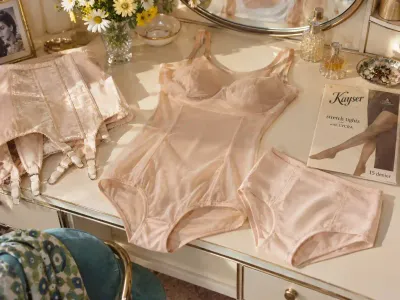
At the start of the 1960s, a respectable woman was expected to wear a girdle every day. By the end of the decade, many young women had never owned one. That's one of the fastest changes in the history of underwear, and I think it's the hidden foundation - quite literally - of the decade's new silhouette.
Several things pushed the girdle out at once. The first was fashion's ideal body. The youthquake replaced the mature hourglass with a slim, straight, boyish figure, and the new clothes - shifts, A-lines, and babydoll dresses - fell from the shoulders rather than clinging to the waist and hips. There was far less for a girdle to do. The second was the hemline. Girdles held up stockings with suspenders, and under a mini skirt that hardware showed. Pantyhose solved the stocking problem without any girdle at all, removing one of its main practical reasons for existing.
The third was a new fibre. DuPont's spandex, sold as Lycra and in commercial production from the early 1960s, could stretch a great deal and snap back, so a much thinner, lighter garment could give the same smoothing effect as a heavy rubber or power-net girdle. Manufacturers responded with lightweight control briefs and panty girdles, "all-in-one" body shapers, and soft, sheer body stockings - one-piece stretch garments that smoothed the whole torso with almost no visible structure. Designers like Rudi Gernreich, whose soft "No-Bra Bra" is covered in his own entry, pushed the idea that underwear should follow the body rather than reshape it.
The last push was cultural. For many young women, the girdle stood for their mothers' generation: stiff, uncomfortable, and tied to ideas of propriety they were rejecting. Going without was a small act of freedom, and it fitted the looser, more youthful fashion of the time. Girdles didn't vanish overnight - older women kept wearing them, and lighter versions stayed in shops for years - but by the late 1960s their place at the centre of women's dressing was gone.
I find it striking that the outer clothes of the 1960s look so simple precisely because the inner clothes got simpler first. The shift, the mini, and the catsuit all depended on a body that wasn't being held in by rubber and bones. And the story continues directly into the decline of foundation garments in the 1970s.