The 1960s mid-1960s
The Babydoll Silhouette
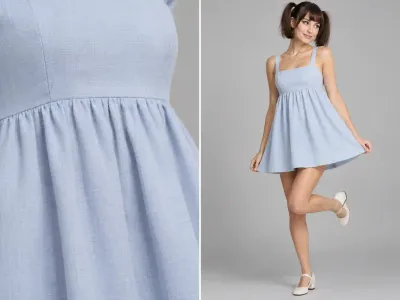
A high, gathered waistline sitting just under the bust with a full, swinging skirt below it - a deliberately childlike shape that made the mini even shorter without making it look overtly sexual.
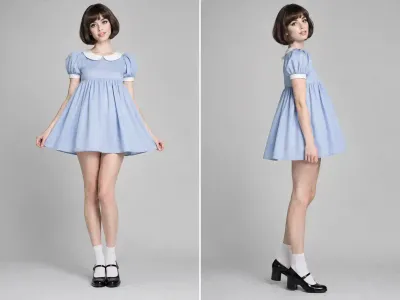
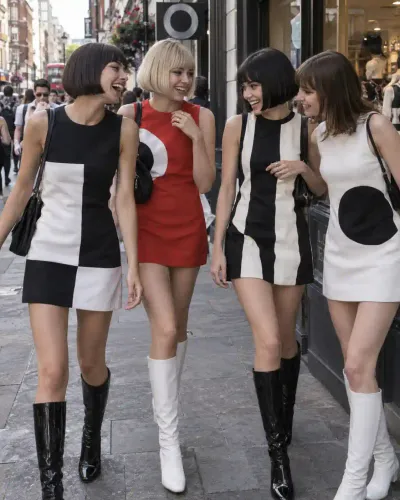
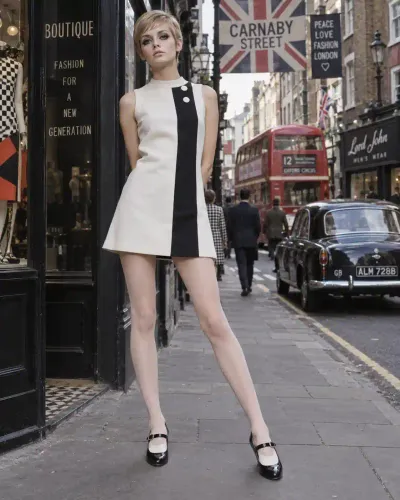
The babydoll silhouette solves a problem the plain mod shift runs into once hemlines climb high enough: past a certain point, a straight, body-skimming mini starts to read as provocative rather than young, and young was what the decade was selling. The answer was to move the waist up and let the fullness start there - a seam just under the bust, and a short skirt that flares or swings out from it, so the dress stands away from the hips and thighs instead of skimming them. It could be every bit as short as any mini, but the shape reads as playful, like a child's party dress.
The name came out of the bedroom, not the nursery. In the 1956 film Baby Doll, Carroll Baker wore a hip-length, ruffled nightie with matching pantalets, and the Museum at FIT credits the film with popularising short, billowing sleepwear. By 1960 "babydoll" was a standard garment category: McCall's pattern 5649 of that year offered a "nightgown, babydoll and brunch coat" for home sewing. FIT's own Vanity Fair nylon tricot nightgown of about 1960 already has the 1960s shape in it - an empire bodice with three ruffled tiers of accordion pleats over a full circle skirt.
Couture got there first. Cristóbal Balenciaga showed a group of flounced lace "Baby Doll" dresses in 1957 and 1958, and the V&A's 1958 example is worth knowing because it shows how different the couture version was. A tight black crêpe de Chine underdress shows through a very wide, flared overdress of semi-transparent black lace by Marescot, with short sleeves, a low waist, a gathered flounced skirt and two giant black satin bows at the neck and waist. The V&A reads the bows as part of the childlike theme, but the waist is low, not high, and the effect is knowing rather than innocent. It belongs with the volume experiments of his sack and tunic more than with a girl's frock.
The 1960s day version raised the waist and shortened everything. In 1964 Simplicity sold pattern 5404, a junior and misses' one-piece dress labelled "All-Season Empire Baby-Doll", with cuffed sleeves, a pocket and a belt, for 65 cents - which tells you the shape had reached ordinary home dressmaking by the middle of the decade. At the other end of the market, André Courrèges made a "Baby Doll" mini dress in 1967, now at FIT, in white crinkle organza: a sleeveless A-line shift with a square neck and an empire seam, covered in pink satin daisies with iridescent paillette centres. Biba did the cheaper, swingier version: the V&A's 1967 Biba mini-dress in purple and yellow zigzag cotton has a fitted bodice with a V-neck, slightly bloused sleeves and a full gathered skirt. How the seam is placed and the skirt set onto it is covered in empire waist construction; what matters here is that the babydoll is where the decade's dressmaking got fuller again after the flat shift.
The doll in the name was meant literally. Short, high-waisted dresses in pale colours, worn on very slender, Twiggy-like bodies, borrowed the proportions of a child's dress for grown women, and the youthquake treated that as a compliment. It's an odd instinct said plainly, but it has never quite gone away: Emma Bunton was still wearing pastel babydoll dresses as Baby Spice thirty years later.
Sources
- Nightgown, Vanity Fair, c. 1960 - The Museum at FIT
- McCall's 5649, Misses' nightgown, babydoll and brunch coat, 1960 - Commercial Pattern Archive, University of Rhode Island
- Evening dress, Cristóbal Balenciaga, 1958 - V&A Collections
- Simplicity 5404, Jr. and Misses' one-piece dress, 'All-Season Empire Baby-Doll', 1964 - Commercial Pattern Archive, University of Rhode Island
- Dress, André Courrèges, 1967 - The Museum at FIT
- Mini-dress, Biba, 1967 - V&A Collections