The 1950s late 1950s
The Sack Dress
A straight, unfitted chemise that hung loose from the shoulder - the decade's last silhouette, and its most controversial.
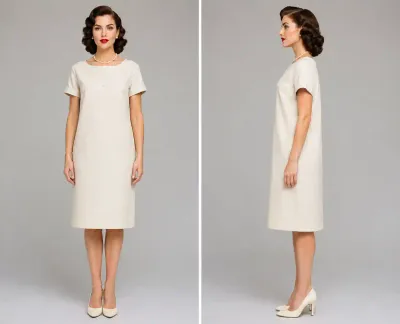
The sack dress is where the decade's cinched-waist obsession finally breaks - no waist seam at all, just a straight drop from shoulder to hem. Both Dior and Balenciaga showed unbelted chemise versions in 1957, but it's Balenciaga's that's usually credited with actually causing the uproar - it landed as genuinely shocking at the time, which is a fun contrast to how tame it reads now.
The press reaction was genuinely fierce, and reads today as almost disproportionate to how mild the actual garment looks in photographs. Fashion writers and cartoonists piled on with real hostility - the dress got mocked as shapeless, unflattering, even actively hostile to the female figure it was supposedly clothing, and "sack" itself started as a derisive nickname before the industry more or less absorbed it as the garment's standard name, the way a few fashion insults have a habit of doing. Part of what made it land as shocking wasn't really the silhouette in isolation - it's how completely it broke with the entire decade's founding logic up to that point. Everything from the New Look forward had been organized around the waist as the silhouette's focal point, cinched, defined, contrasted against fullness above or below it; the sack dress simply removed that organizing idea altogether, and a decade's worth of fashion press had a lot invested in the cinched waist being the whole story.
What I find most interesting, looking back, is how quickly "shocking" turned into "prophetic." Within a year, Yves Saint Laurent's trapeze line picked up the same unfitted, waist-skipping logic and pushed it even further at the house of Dior itself - about as establishment an endorsement as a controversial idea could get - and by the early 1960s, loose, unfitted shift dresses had become entirely mainstream daywear rather than a scandal. The sack dress is really the moment the decade's silhouette logic cracks open, three years before the '60s officially start; everything that follows about that decade's looser, younger shapes is arguably just this idea losing its capacity to shock.