The 1960s mid-1960s
André Courrèges
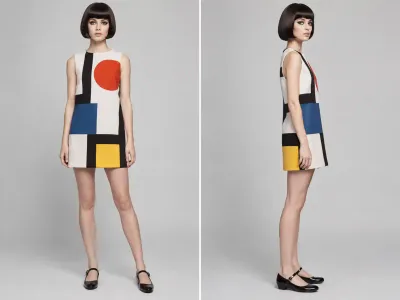
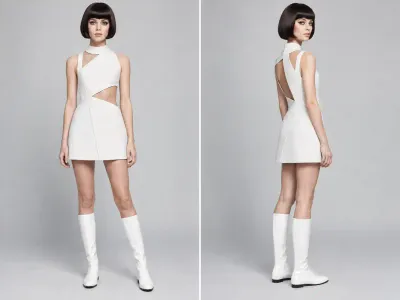
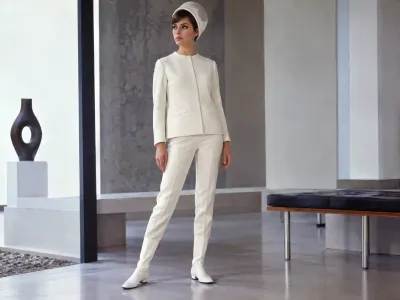
The couturier whose 1964 collection - the press's 'Moon Girl' - gave Space Age fashion its clearest visual manifesto - white, geometric, and built from fabric that held its own shape.
André Courrèges trained under Balenciaga, and then spent his own career pointing that structural discipline somewhere Balenciaga never went. Born in Pau in 1923, he studied engineering before turning to fashion, and the Kyoto Costume Institute records that he worked for eleven years from 1950 as a cutter in Balenciaga's house. He left in 1961 to open his own, with his wife Coqueline as his closest collaborator. The Kyoto museum also notes he had been making trousers for women since 1963, and unlike Saint Laurent he didn't adapt menswear to do it. He designed new shapes for young women from scratch.
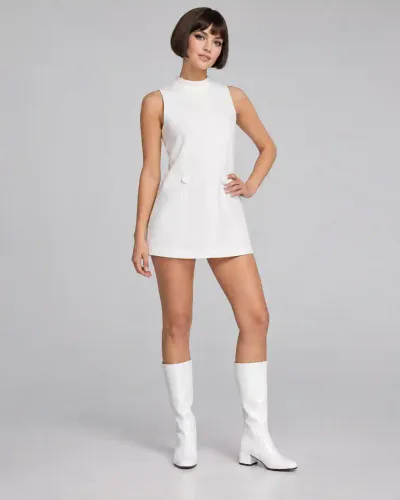
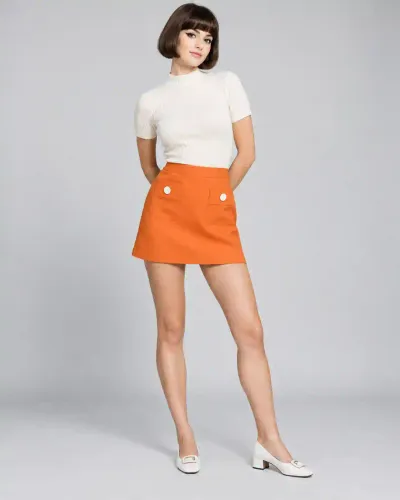
The spring 1964 collection is the one everyone remembers. British Vogue called 1964 "the year of Courrèges," and the V&A describes the show as precision-tailored short skirts and slim trousers with boxy jackets, all meant to be worn with flat, square-toed shoes or boots and short white gloves. Paula Reed, quoted on FIT's Fashion History Timeline, adds that the stiff shapes came from heavyweight fabrics like gabardine, that some outfits had cut-outs exposing the back, waist or midriff, and that they were often worn without a bra. The "Moon Girl" look became the clearest reference point for the whole Space Age silhouette, stark white and silver with hemlines well above the knee - a startling choice for Paris couture rather than the London street. Who got to the short skirt first, he or Mary Quant, is still argued over in the mini skirt entry.
What separates Courrèges from a designer borrowing a futuristic mood is how literally structural the clothes are. The V&A's red wool gabardine mini-dress of 1966 is an A-line with a low square neck, no sleeves, and two false pockets. Three welt seams mark each section of the construction, the bodice cut under the bust and the two parts of the skirt, and the hem is welted too, purely to stiffen it. A coat-and-dress ensemble from 1965, in heavy cream worsted trimmed in blue, has every seam doubled. As a dressmaker I read those welts as Balenciaga's lesson in a new accent: the seams carry the shape, so nothing underneath has to.
He treated the boots as part of the same logic. The V&A's pair from 1965 are white leather ankle boots with pleated cuffs and self-bows, flat black plastic soles, and a zip down the back covered by Velcro plackets. The museum notes that flat white boots were essential for girls copying the Moon Girl image, and cheaper versions were soon on the high street - the start of the go-go boot. Not everyone was charmed. In 1966 Chanel said he was "trying to destroy women by covering up their figures and turning them into little girls," and Courrèges did borrow freely from children's yokes, pinafores and dungarees.
Copying was the price of that influence. FIT's timeline records that after a trip to America in 1965 the couple found their designs being copied, so they devised a logo of their intertwined initials and put it on the outside of the clothes. In 1967 he added Prototype, a made-to-order line, and at the end of the decade a luxury ready-to-wear line, Couture Future. His trouser suits and the timing of the space race did the rest. The discipline passed on too. Emanuel Ungaro left Balenciaga to work for him in 1964 before opening his own house in 1965.
Sources
- Mini-dress, André Courrèges, 1966 (T.99-1974) - V&A Collections
- Ensemble (coat and dress), André Courrèges, 1965 (T.304:1&2-2000) - V&A Collections
- Pair of boots, André Courrèges, 1965 (T.109&A-1974) - V&A Collections
- Pantsuit, André Courrèges, Autumn/Winter 1969 (AC5713 87-46-2AB) - Kyoto Costume Institute Digital Archives
- "1963-1969 - André Courrèges, Coat" - Fashion History Timeline, Fashion Institute of Technology
- Jennifer Park, "Courrèges, André" - Encyclopedia of Clothing and Fashion, via Encyclopedia.com