The 1960s early-to-mid 1960s
The A-Line Cut
A pattern-cutting approach that flares gently from shoulder or bust to hem with no waist seam at all - named, quite literally, for the letter A its silhouette traces.
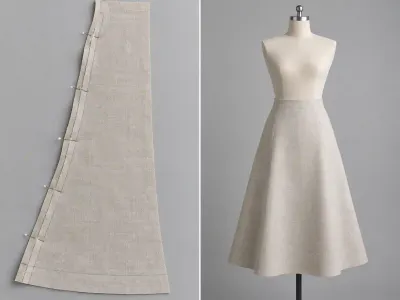
The A-line is one of the more literal names in garment construction - cut a dress or skirt so it's narrower at the shoulder or bust and flares out gradually toward a wider hem, and the resulting outline traces the letter it's named for. Christian Dior had actually introduced the term back in 1955 for one of his own collections, but it's this decade, particularly its opening years, where the cut becomes a genuine everyday construction default rather than one couture season's specific silhouette.
What makes the A-line worth a standalone construction entry, rather than treating it as just a description of a finished shape, is how directly it solves a specific pattern-cutting problem: how do you flare a garment away from the body without relying on the fitted waist seam and separate, gathered skirt panel that most earlier flared silhouettes needed? The A-line's answer is to build the flare into the side seams themselves, angling them outward gradually from bust or shoulder straight down to hem in one continuous line, with no waist seam breaking up the garment at all. That's a genuinely simpler construction than a fitted bodice joined to a separate gathered or pleated skirt - fewer pattern pieces, less seaming, less fitting work overall - which made it both faster to manufacture at scale and more forgiving to actually wear, since there's no precise waist measurement the garment depends on to look right.
That construction simplicity is exactly why the A-line pairs so naturally with the decade's move toward mass-produced, youth-oriented ready-to-wear rather than fitted couture - it's a direct ancestor of the even simpler, fully dartless shift dress and the broader mod silhouette that follows it by a few years. I think of the A-line as this decade's construction transition piece: still recognizably a "cut and fitted" garment in the traditional dressmaking sense, but already pointing hard toward the flat, minimal, dart-free construction that would define the era's second half.