1920–1929 · 31 deep dives
The 1920s
Dropped waists, bobbed hair and the first hemlines to show the knee - the decade fashion went straight, short and modern, and beaded it for the evening.
An introduction
In 1919 the Hon. Mrs Anthony Henley went to celebrations around the Paris Peace Conference in an evening dress by Coco Chanel, now in the V&A. It is a straight, sleeveless tunic of white chiffon over black net, banded with beads, with no waist to speak of. Only its length belongs to the old world. The war had loosened things: designers had lifted hems several inches off the floor in 1915, munitions workers had worn overalls and trousers, and by the peace a barrel-like line had arrived in which, as James Laver put it, "an attempt was made to confine the body in a cylinder." The 1920s spent ten years deciding how short that cylinder should be.
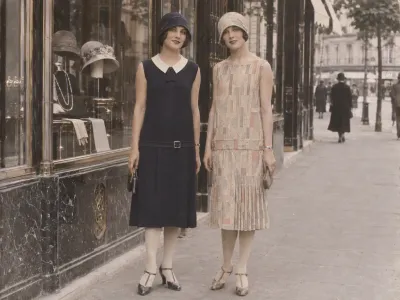
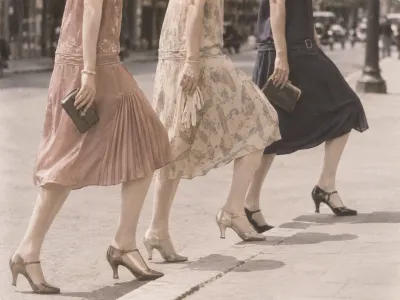
At first, not very. The early-1920s chemise hung from the shoulders with any waist marking low and the hem at the calf or ankle. Designers tried to lengthen skirts between 1922 and 1924; many women protested, and won. The line flattened into the garçonne silhouette, named after a scandalous novel of 1922, and the hem climbed: ten to twelve inches off the floor in 1925, about fifteen by 1927. Even at its peak, around 1926-28, the knee-length hemline sat just below the knee. Sitting, dancing or climbing into a car showed it.
Under the tube, though, went a bandeau to flatten the bust, often hooked to a corset below, or a corselette smoothing the body from bust to thigh. One department-store buyer called the abandonment of corsets "a myth." The corset had changed its job, from pinching a waist to erasing one: a black satin evening dress of about 1925 measures more round the waist than round the chest.
Day clothes came from the games field. Chanel had made jersey, a knit for men's underwear and sport, fashionable from 1916, and early in the decade opened her own factory to make it. Jean Patou dressed Suzanne Lenglen for tennis from 1921 and sold golf and tennis clothes from Le Coin des Sports, opened in a year usually given as 1925. The sportswear silhouette made a uniform of a pleated skirt under a jumper or the unlined jacket of the cardigan suit, and by 1928 The Tatler found sports clothes worn "until the hour of cocktail."
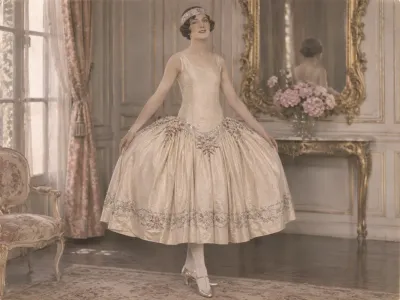
Not every house wanted the tube. Jeanne Lanvin built her name on the robe de style, a plain bodice over a wide skirt, sometimes held out on panniers. Madeleine Vionnet, reopened in 1918 or 1919, spent the decade fighting copyists, even putting her fingerprint on her labels. She had trained at Callot Soeurs, the sisters' house of lace, lamé and Chinese silks, which joined Lanvin among the four couture houses given the Pavillon de l'Élégance at the 1925 Exposition. The Exposition's geometry had absorbed the lotus and scarab motifs of Tutmania, set off by Howard Carter's find in November 1922.
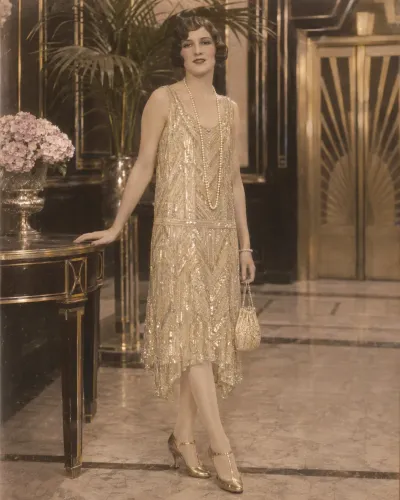
For evening the tube was covered in glass. A beaded evening dress was usually silk chiffon or georgette over a matching slip, its bugles and sequins chained on from the back with a tambour hook, so the embroiderer never saw the right side until the frame was turned over. Panels were beaded flat and only then cut, which is why Jenny's "Jour de Veine" is just a front and a back. I love that so plain a cut carried such heavy needlework. The weight is why so few survive; the tiered, fringed "flapper dress" of the costume shop probably owes more to later costume than to them.
The flapper began as British slang that America turned into a type, and she got the vote: in America in 1920, in Britain, at 21, in 1928. Her hair went from bob to shingle to Eton crop, short enough for a cloche pulled down to the eyebrows. The Charleston, on Broadway from 1923, wanted dresses hung loose from the shoulders, and in Paris from October 1925 Josephine Baker made her slicked crop famous enough to sell a hair gel.
Most women never saw Paris. A dress that only had to fit at the shoulders was the easiest fashionable garment ever to make at home: Butterick promised in 1921 that with its instruction sheet "It isn't necessary to know anything about dressmaking," and Simplicity sold patterns at 15 cents from 1927.
The way down began in 1928, when designers lowered hems and waists began to rise. Handkerchief points, floating panels and dipping backs suggested length before the hem committed to it, and the 1927 New Butterick Dressmaker told readers to let such a skirt hang for two or three days before levelling it, as I still do. Some women, the New York Times reported in 1929, called the long skirt "an insidious attempt to lure women back into slavery." Patou led the drop anyway, and by 1930 the natural waist was back.
Sources
- Karina Reddy, "1920-1929" (decade overview) - Fashion History Timeline, Fashion Institute of Technology
- Karina Reddy, "1910-1919" (decade overview) - Fashion History Timeline, Fashion Institute of Technology
- Pamela A. Parmal, "Hemlines", Encyclopedia of Clothing and Fashion - Encyclopedia.com
- Evening dress, white chiffon and black net, Coco Chanel, 1919, worn by the Hon. Mrs Anthony Henley (T.85&A-1974) - V&A Collections
Silhouettes 5
-

The Early-1920s Chemise
Loose, low-waisted and still long: the straight chemise dress of the early 1920s, hanging from the shoulders to the calf or ankle before the hem began its famous climb.
-
The Garçonne Silhouette
A straight tube from shoulder to hem, the bust flattened and the waist dropped to the hip: the boyish line named after a 1922 scandal novel, and the shape most people picture when they think of the 1920s.
-
The Knee-Length Hemline
The 1920s skirt was at the knee for only two or three years, around 1926-28, and even then rarely above it. How short it really got, what it did for stockings, and how uneven hems led it back down.
-
The Robe de Style
A fitted bodice, a low waist and a wide skirt, sometimes held out on panniers: Jeanne Lanvin's romantic answer to the tube, worn all decade by women the straight line didn't suit.
-
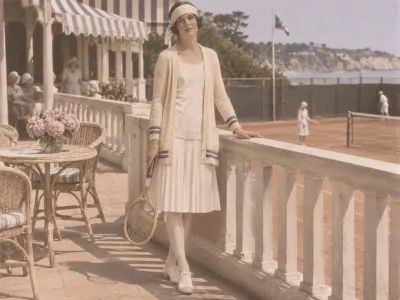
The Sportswear Silhouette
Pleated skirts, jersey and cardigans: how clothes made for tennis, golf and the beach became what fashionable women wore every day, led by Patou and Chanel.
Designers 5
-
Callot Soeurs
Four sisters, a lace shop and a house famed for gold lamé and Chinese silks: Callot Soeurs trained Vionnet, dressed duchesses and still stood among Paris's elite in 1925.
-
Coco Chanel
Jersey for day, beads and black for evening, glass and gilt for jewellery: the decade Gabrielle Chanel built her house, her own textile mill and the legend the century remembers.
-
Jean Patou
Sportswear, six American mannequins, a dress with a light bulb in it: how Jean Patou turned 7 rue Saint-Florentin into the house that ran Chanel closest in the 1920s.
-
Jeanne Lanvin
A milliner who began by dressing her daughter, Lanvin spent the 1920s defying the boyish line with full-skirted robes de style, her own embroidery workrooms and a favourite Fra Angelico blue.
-
Madeleine Vionnet
Greek vases, Thayaht's logo, a mansion on the avenue Montaigne and a running war with copyists: the business side of the decade Vionnet perfected her cut.
Garments 5
-
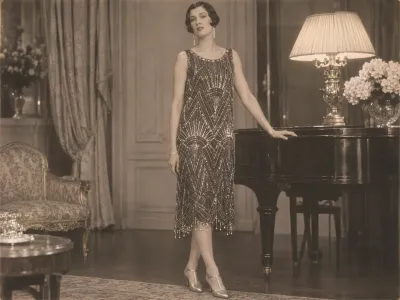
The Beaded Evening Dress
A straight tube of chiffon, georgette or net, covered in glass beads and sequins and made for dancing. Heavy, fragile and rarely intact today, and much less fringed than the costume version suggests.
-
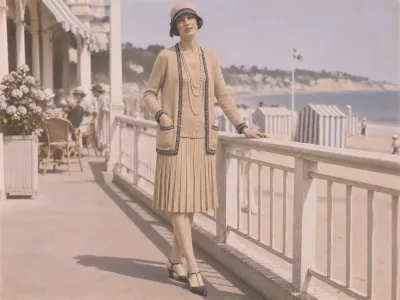
The Cardigan Suit
An unlined, collarless jacket that opened like a cardigan, a straight skirt and a jersey sweater: sportswear turned into town clothes, and copied by everyone from the House of Worth to the home knitter.
-
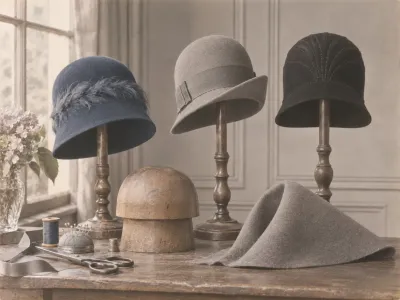
The Cloche Hat
A deep, bell-shaped hat of moulded felt or straw, pulled down to the eyebrows over a cropped head: the hat of the decade, and one that needed short hair underneath.
-
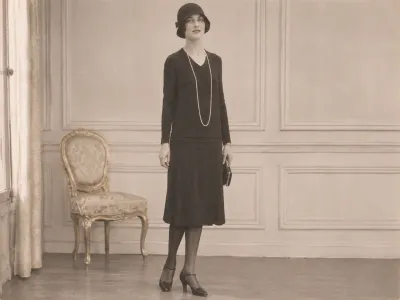
The Little Black Dress
In October 1926 American Vogue called a plain black Chanel day dress a 'Ford', the frock the whole world would wear. The prediction came true. The idea that she invented black is another matter.
-

The T-Bar Shoe
Bar and T-strap shoes on curved Louis heels: strapped on so they stayed on, and suddenly on show once hems rose to the knee. Made by everyone from the high-street shop to André Perugia.
Fabrics & Textiles 5
-
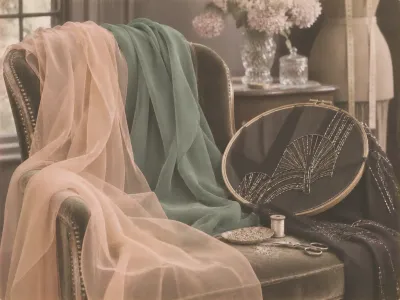
Chiffon and Georgette
The sheer silks of the decade: almost weightless chiffon and grainy georgette crêpe, layered over slips and used as the ground that carried the beading of the evening dress.
-
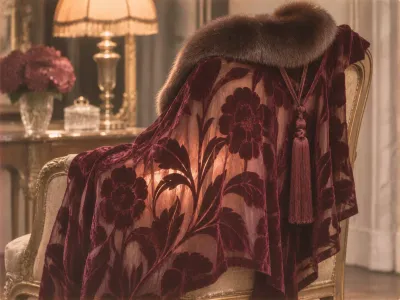
Devoré and Velvet
Velvet made light enough to drape: transparent chiffon velvets, and devoré, where a chemical paste burns the pile away in a pattern. The fabric of the decade's evening coats and wraps.
-
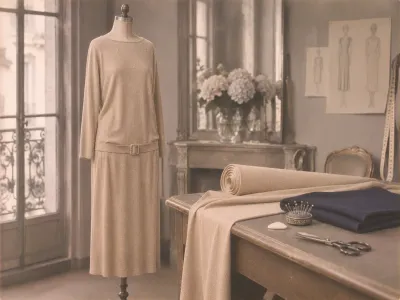
Jersey
A knitted fabric once kept for underwear and sport, which Chanel made fashionable from 1916. Its stretch and easy hang suited the loose, uncorseted line of the 1920s.
-
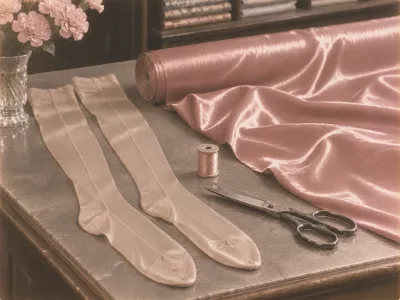
Rayon and Artificial Silk
Shiny, cheap and weak when wet: the regenerated-cellulose 'artificial silk' that put silky stockings and dresses within reach, and was renamed rayon in 1924.
-

Sonia Delaunay and Simultaneous Fabrics
A painter's colour theory turned into printed silks, embroidered coats and scarves, sold from her own Paris atelier and from a boutique on a bridge at the 1925 Exposition.
Construction & Fit 5
-
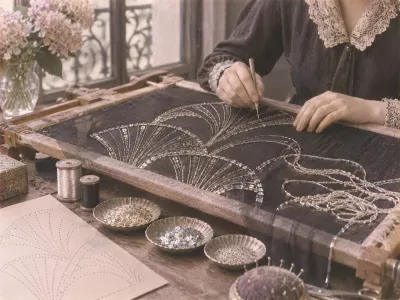
Beading and Embroidery
How a beaded dress was made: glass bugles and sequins chained on with a tambour hook, panels worked flat before cutting, and the Paris houses, Kitmir and Lesage, behind the couture versions.
-
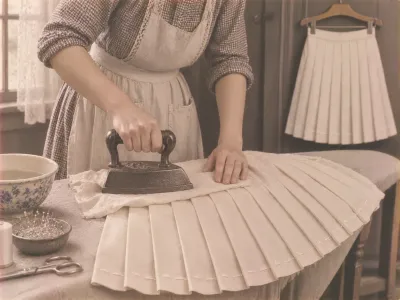
Knife Pleats and the Pleated Skirt
Pleats gave a knee-length tube skirt room to stride, play tennis and dance, but in wool, silk and cotton they had to be basted, pressed and set again after every wash.
-
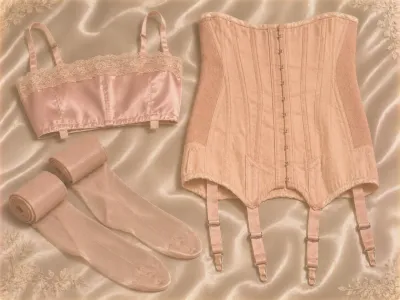
The Bandeau and the Corselette
What went under the straight line: bust-flattening bandeaux, light elastic girdles and the all-in-one corselette, and the first bras with cups that pushed back against the boyish form.
-

The Handkerchief Hem
Points, floating panels, dipping backs and trains: how dressmakers of 1926-29 lengthened the line of a knee-length dress before the hem itself was allowed to fall.
-

The Straight Cut and Home Dressmaking
A dress with almost no fitting and a handful of pieces was the easiest fashionable garment ever to sew at home, and the pattern companies made sure women knew it.
Culture & Context 6
-

Jazz and the Charleston
A dance from the Gullah Sea Islands reached Broadway in 1923 and the whole world by 1925. What dancing it asked of a dress: short, light, loose, hung from the shoulders, and a shoe that stayed on.
-

The 1925 Paris Exposition
The 1925 Paris exhibition of decorative arts put couture in a pavilion of its own, Poiret on three barges and Sonia Delaunay in a boutique on a bridge. How fashion presented itself as a modern art.
-
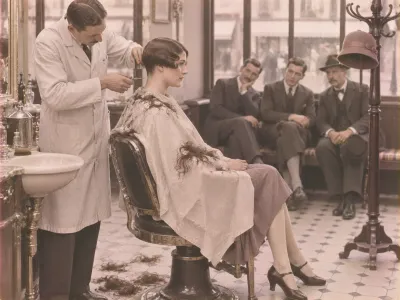
The Bob
From Irene Castle's hospital haircut to the shingle and the Eton crop: how short hair went from scandal to standard in ten years, and why the cloche hat could not have existed without it.
-
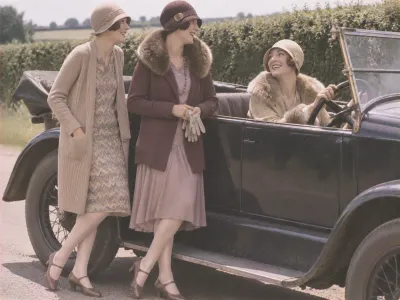
The Flapper and the Modern Girl
The flapper was a British slang word long before she was an American icon. How a newspaper type with bobbed hair, a vote and a cigarette changed what ordinary women wore.
-
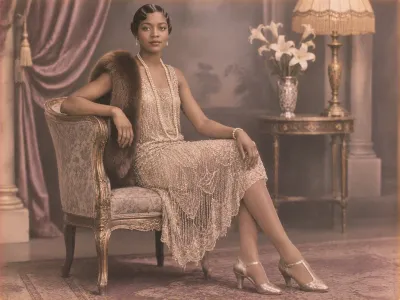
The Harlem Renaissance and Josephine Baker
Harlem's studio portraits, the Walker hair-care fortune and a 19-year-old dancer who took Paris in 1925: Black women's style in the 1920s, and who profited from it.
-

Tutankhamun and Egyptomania
Howard Carter found a step in the Valley of the Kings in November 1922; by February 1923 businessmen wanted Egyptian designs for gloves, sandals and fabrics. What 'Tutmania' put into wardrobes.