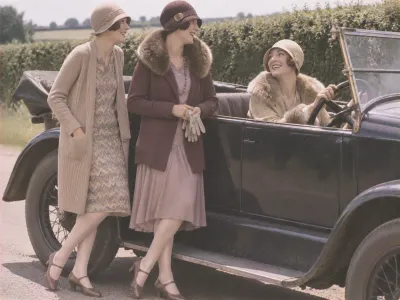
The 1920s early-to-mid 1920s
Tutankhamun and Egyptomania
Howard Carter found a step in the Valley of the Kings in November 1922; by February 1923 businessmen wanted Egyptian designs for gloves, sandals and fabrics. What 'Tutmania' put into wardrobes.

On 4 November 1922, according to the Griffith Institute's record of Howard Carter's first season, his workmen in the Valley of the Kings uncovered the top step of a staircase cut into the bedrock. Carter covered it again and cabled his patron, Lord Carnarvon: "At last have made wonderful discovery in Valley, a magnificent tomb with seals intact." On 26 November he made a small breach in the second sealed doorway and looked in by candlelight. The official opening followed within days, and on 16 February 1923 the sealed doorway to the burial chamber was opened in front of government officials. Carnarvon died in Cairo on 5 April. Every one of those dates was news.
The press is the reason this became a fashion story. The Times of London paid Carnarvon £5,000 for exclusive rights to report the clearance, National Geographic notes, and it published 26 articles before it lost the exclusive in 1925. Everyone else made do with colour. A New York Times correspondent in Luxor declared in February 1923 that "Tutmania had arrived." On 7 February the same paper reported that "business men all over the world plead for designs for gloves, sandals and fabrics," and by 2 April it was describing a "Tut-ankh-Amen hat," a bonnet shape between a picture hat and a toque.
The goods followed in months. The ASU FIDM Museum has a blue and white printed textile of about 1923 with a swagged lotus border, a cartouche filled with dark blue dots and winged figures borrowed from Egyptian gods and goddesses. It also has an embroidered dress of the same date, a yellowy-gold ground with touches of blue and red, the colour pairings people then thought of as ancient Egyptian. Its motifs are simplified shapes that only resemble hieroglyphs, and the museum thinks it was probably made at home by a skilled embroiderer working from newspaper pictures or needlework patterns. I love that: a woman reading about the tomb over breakfast and putting it on her own dress. National Geographic lists the rest of the craze: lotus and sphinx dress prints, imitation hieroglyphs on glove wristbands, cobra headbands and snake bracelets, kohl eyeliner and Egyptian-style powder compacts, and a winged scarab brooch from Cartier.
Two V&A pieces show how it reached ordinary accessories. A French handbag of about 1924 is green felt with bands of black and gold leather and an appliqué of birds in an Egyptian style, with a brass clasp trimmed in lapis-blue and a little vanity mirror tucked inside. And a square shawl of printed silk chiffon with a deep gilt border, made in Lyon about 1925, carries a V&A note that gold and silver clothing became especially fashionable after Carter's discovery. Shimmer suited the beaded evening dress, where scarabs, lotus flowers and stepped pyramids were easy shapes to work in bugle beads (see beading and embroidery).
The tomb did not invent any of this, though. Karin Bohleke's study of earlier Egyptian revival dress shows a century of previous waves, each set off by a new discovery. She finds the dancer Irene Castle in the Ladies' Home Journal of October 1914 wearing a dance dress printed with a cartouche, a vulture and a duck. She also warns about Assiut cloth, the Egyptian cotton net clamped with little strips of silver metal: museums often date it to the 1920s because it looks so right with the flapper line, but travellers were bringing it home as souvenirs by 1910 and earlier, and it appears on a dance dress on 1914 sheet music. So a lotus print is not automatically 1923.
What Carter's find did was turn a long-running taste into a craze with a date attached. The Egyptian motifs then folded into the geometric vocabulary on show at the 1925 Paris Exposition, and they outlived the headlines in the stepped and fanned shapes of Art Deco prints.
Sources
- 1st Season (1922-1923) - Tutankhamun: Excavating the Archive, Griffith Institute, University of Oxford
- "How King Tut conquered pop culture" - National Geographic History
- Egyptomania (textile 99.274.114 and embroidered dress S88.644.2, c. 1923) - ASU FIDM Museum
- Handbag, felt and leather with Egyptian-style appliqué, France, ca. 1924 (T.236&A-1972) - V&A Collections
- Shawl, printed silk chiffon with gilt threads, possibly Lyon, ca. 1925 (T.248-1981) - V&A Collections
- Karin J. Bohleke, "Mummies are Called upon to Contribute to Fashion: Pre-Tutankhamun Egyptian Revivalism in Dress", Dress 40:2 (2014), Costume Society of America