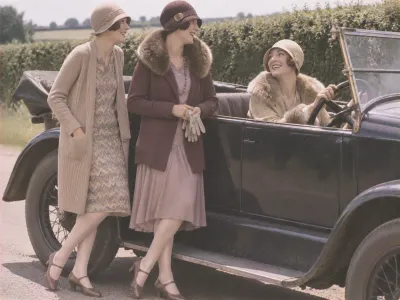
The 1920s throughout the 1920s (peak mid-decade)
The Cloche Hat
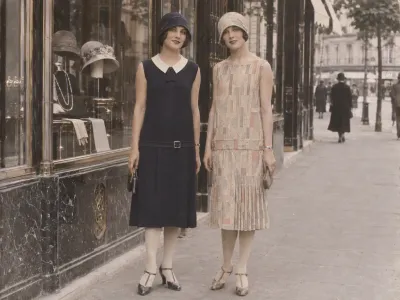
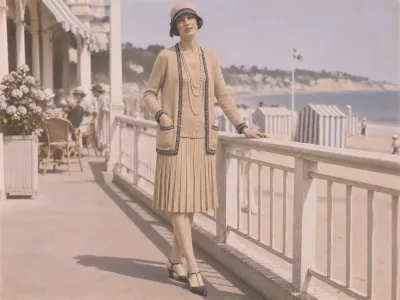
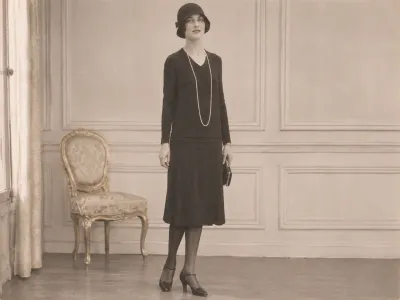
A deep, bell-shaped hat of moulded felt or straw, pulled down to the eyebrows over a cropped head: the hat of the decade, and one that needed short hair underneath.
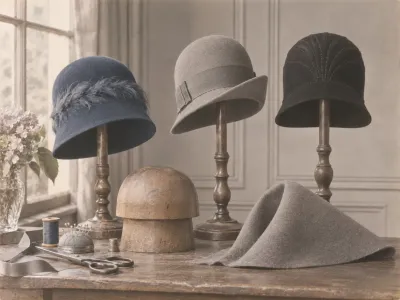
In 1929 a bride went to her second wedding in a Lanvin day suit of pink marocain from the autumn/winter 1929-30 collection and a pale pink felt cloche from Miss Fox, a milliner in Hanover Square. She later told the V&A, which has both, that the hat was a "copy of a French model, purchased at the same time as the dress, and is characteristic of what was very smart indeed at that time." It is eight inches deep, with a crown rounded "as a skull" and a brim that is pleated on the left, where the felt was cut longer to make room for the folds. That depth is the whole point. A cloche (the French word for a bell) was not perched on the head. It was pulled down over it, to the eyebrows at the front and the nape at the back.
The shape is usually credited to Caroline Reboux, the Paris milliner who had once made hats for the Empress Eugénie, and you will often see it dated to 1908, though the evidence for a single moment of invention is thin. The Museum at FIT calls her "a pioneer of this soft style" and explains what was new: the cloche "eschewed the rigid wire frames of the 19th century in favor of soft felts and straw, which could be draped and moulded to hug the curves of the newly bobbed head." In the 1920s, the V&A says, Reboux was most admired for cloches "often cut and formed on the client's head," and FIT has one from 1929, of black straw with black velvet.
Felt is what made that possible. Milliners bought felt as a ready-made cone, called a hood, steamed it soft, pulled it down over a wooden block the shape of the crown, pinned or tied it at the headline and left it to dry hard. Reboux skipped the block and shaped the felt on the client. The Miss Fox hat is "fur felt moulded to shape," which is the finer sort: felted from rabbit or beaver fur rather than wool, so it holds a crisp line and takes a fold well. Fit mattered, because with no bun of hair to pin into there was nothing else to anchor it. The blue felt cloche Liberty made in 1928 for Marian Hazel Lasenby's wedding to the potter William Moorcroft is lined in cream silk taffeta with a drawstring, so it could be pulled snug.
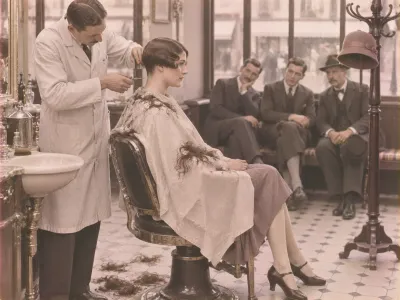
That snug fit needed short hair. The V&A describes the Liberty hat as one that "fitted snugly over fashionably closely-cropped hairstyles," and the London Museum, describing a brown felt cloche embroidered in braid, made in Paris and sold by Dickins & Jones, says it "perfectly matched short hair and tubular dresses." FIT's timeline traces hair growing shorter through the decade, from the bob to the shingle and then the Eton crop, the ideal cut for showing off a cloche. A deep bell over a head of long, pinned-up hair simply would not go on.
Within that one shape there was a lot of variety. The V&A's Kilpin cloche of about 1925 is pink plaited straw with a band of brown chevrons and stylised flowers appliquéd in felt and velvet, and the museum notes that the high, rounded crowns invited pleating, beading, embroidery and appliqué. It also dates the brims: small brims at the front from 1922 to 1925, then longer, asymmetrical ones from 1926.
By the end of the decade, FIT notes, women were starting to grow their hair longer again, and a hat that swallowed the whole head left nowhere to show off a wave. The cloche lingered into the early 1930s, but the new hats were small and worn at an angle. The tilted hat entry picks up the story, with Reboux, now under Lucienne Rabaté, still at the centre of it.
Sources
- Cloche, pink fur felt, Miss Fox, London, 1928-1929 (T.203-1931) - V&A Collections
- Cloche hat, felt and ostrich feathers, made for Liberty & Co., London, 1928 (T.71B-1982) - V&A Collections
- Hat, plaited straw with felt and velvet appliqué, Kilpin Ltd, London, about 1925 (T.442-1977) - V&A Collections
- Hat, suede and monal pheasant feathers, Lucienne Rabaté for Caroline Reboux, 1946 (T.384 to B-1974), with notes on the House of Reboux - V&A Collections
- Caroline Reboux, cloche of black straw with black velvet, 1929 (P83.39.16), Arbiters of Style - The Museum at FIT
- Hat, brown wool felt with braided embroidery, sold by Dickins & Jones, 1925-1930 (64.119/5) - London Museum
- "1920-1929" - Fashion History Timeline, Fashion Institute of Technology