The 1920s throughout the 1920s
The Flapper and the Modern Girl
The flapper was a British slang word long before she was an American icon. How a newspaper type with bobbed hair, a vote and a cigarette changed what ordinary women wore.
On 8 June 1919 the Washington Times ran a short item headed "British Flappers Like Morning 'Nip.'" That October the same paper reported that "British Flappers Can't Land Jobs." Both headlines, now listed in the Library of Congress's newspaper guides, treat the flapper as something foreign. In 1919 she was. The word was British, and it had a long and not very respectable past.
The lexicographer Jonathon Green traces it through some unpromising company. Barrère and Leland's slang dictionary of 1889 defines "flappers" as "very young girls trained to vice," and English dialect had "flap" for a girl of loose or giddy character; the usual explanation is a fledgling bird, flapping before it can fly. By the early 1900s the British word had softened into something like "schoolgirl" or "teenager": the Sporting Times wrote of "the dear little flappers in the chorus" in 1908, and a naval memoir of 1914 used it for little pigtailed girls. America took the word and turned it into a type. Fitzgerald's first story collection, Flappers and Philosophers, and the Olive Thomas film The Flapper both came out in 1920, and The Flapper magazine printed a "Flapper Dictionary" in its first issue in June 1922.
The vote is part of the story, and in Britain it gave the word a sneer. Women under thirty still could not vote there, and The Times was already dismissing the idea of giving it to them as "the flapper vote" in 1920. The Equal Franchise Act, which gave women of 21 the vote on the same terms as men, received royal assent on 2 July 1928, and the general election of 30 May 1929 was promptly nicknamed the "Flapper Election." In the United States the 19th Amendment was ratified on 18 August 1920, when Tennessee became the 36th state to approve it, though the National Archives is careful to add that discriminatory state laws kept many Black and other minority women from voting for decades.
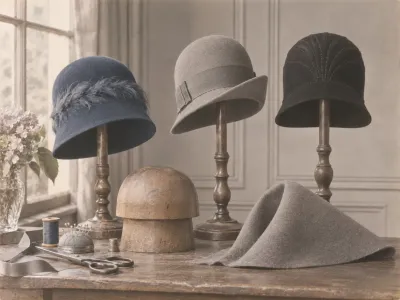
By 1922 the newspapers had a fixed picture of her. The Weekly Journal-Miner in Prescott, Arizona, printed "Typical Flappers" in August that year, labelled from head to toe: bobbed hair, a felt hat, a skirt above the knee (a caricature: real hems that year were far longer). The Library of Congress sums up her habits as a list of new freedoms: she might drive a car, smoke, vote, drink and dance the Charleston. Zelda Fitzgerald was cast as the living example whether she liked it or not, and Clara Bow, in films such as Black Oxen (1923), made her a screen type. She was also news because she worried people: "Big Business Banishes the Flapper," the Morning Tulsa Daily World announced in July 1922.
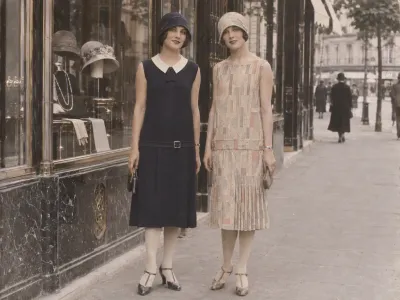
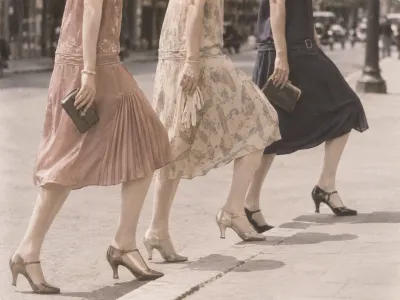
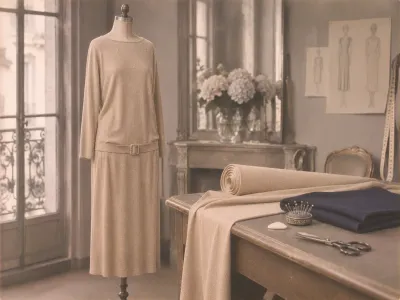
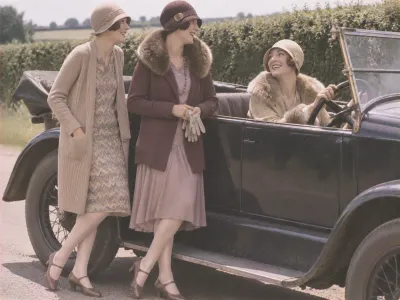
For clothes, the flapper meant the straight, low-waisted garçonne line, lipstick, rolled stockings and a hem that, the Fashion History Timeline notes, kept rising until 1926. What interests me more is how far the look travelled beyond the girls in the headlines. Its simple lines, FIT points out, let women of all means copy it, often at home and in cheap jersey or artificial silk. A straight tube with a dropped waist is about the easiest dress there is to cut, which is why home dressmakers took to it so readily.
So how many women were flappers? Nobody counted, and the honest answer is that very few lived the whole package. As Chris Routledge puts it, the wildest excesses were open only to the very rich, but many American women took up the clothes and some of the liberties. A farmer's wife in 1926 might have a shorter skirt, a bob and a cloche without ever setting foot in a speakeasy. The flapper was a young, urban, largely middle-class figure, and as much a creation of journalists, novelists and film studios as a real person. By the early 1930s, Routledge notes, most of them were married with children, and the natural waist and longer hem had already come back.
Sources
- Jonathon Green, "The Flapper" (from Sounds and Furies, 2019) - Mister Slang, 10 June 2024
- Amber Paranick, "Those Fluttering Flappers!" - Library of Congress, Headlines & Heroes blog, 8 May 2018
- Flappers: Topics in Chronicling America, selected articles - Library of Congress Research Guides
- 19th Amendment to the U.S. Constitution: Women's Right to Vote (1920) - National Archives
- "After the vote: post-1928 women" - Women's History Network, July 2013
- Chris Routledge, "Flappers", Bowling, Beatniks, and Bell-Bottoms - Encyclopedia.com
- 1920-1929 - Fashion History Timeline, Fashion Institute of Technology