The 1920s late 1920s (about 1925-1929)
The Knee-Length Hemline
The 1920s skirt was at the knee for only two or three years, around 1926-28, and even then rarely above it. How short it really got, what it did for stockings, and how uneven hems led it back down.
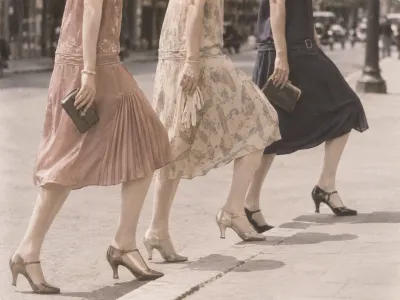
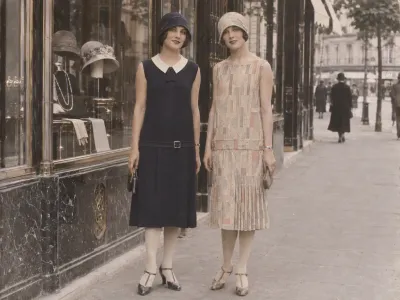
"It is often assumed that all dresses were short during the '20s." That line comes from a gallery label at the Indianapolis Museum of Art, written for an American wedding dress of 1925 that is 45 inches long and trails a train of 102 inches, and it corrects a persistent myth. The label goes on: skirts were at their shortest "only between 1926 and 1928, when the whole leg, up to the knee, was exposed." I suspect the popular image of the flapper in a fringed dress halfway up the thigh owes more to fancy dress than to anything in a museum. The 1920s skirt reached the knee for two or three years and almost never went past it.
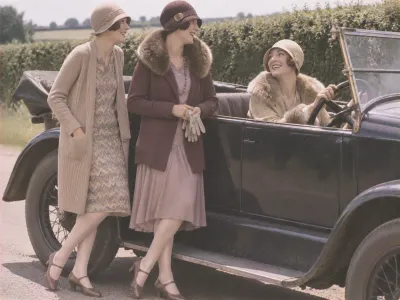
The numbers bear that out. The historian Pamela Parmal, writing on hemlines, notes that the fashion press of the day "slavishly reported on how many inches above the floor" each season's models were hemmed. In 1925 that was ten to twelve inches. By 1927 it was about fifteen, which she describes as just below the knee. Sources differ by a year on the peak (Parmal says 1927, the Indianapolis label 1926 to 1928), but none of them puts it before 1926, and none of them puts it above the knee. On a woman of average height, fifteen inches from the floor still covers the knee when she stands. It's the sitting, dancing and stepping into motor cars that showed it, which is why the Charleston did so much for the hemline's reputation.
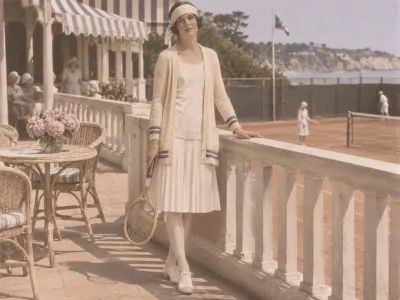
You can watch women chasing the length. The V&A has a black satin day dress of 1925, made by Madame Hayward and printed with sprigs of field flowers, that is straight cut with two tucks at the hip and sits "just below knee length." The record adds a small, telling note: "The hem has been raised." Its owner shortened it, presumably to keep up. Not everyone did. A gold panne velvet wedding dress at the V&A, worn by Maud Cecil at St Margaret's, Westminster, on 17 November 1927, is ankle-length, and the museum notes that while some brides of 1926 were already marrying in knee-length dresses, others chose the traditional length.
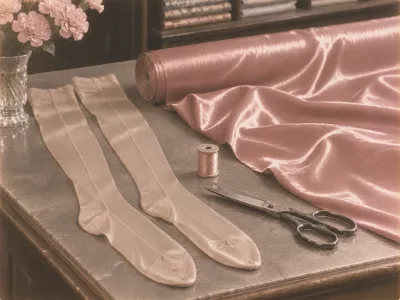
What the short skirt really changed was the leg. For grown women this was new: stockings on show from ankle to knee in the street, and they became a fashion item in their own right. The V&A credits Jean Patou with consistently championing "the shorter length of skirt that did much to stimulate the demand for stockings." A blue silk pair of about 1925, worn by Emilie Grigsby, a wealthy American living in England, are fully fashioned and machine-knitted in ribs, with a vertical stripe worked into the knitting. Silk was expensive, which helped cheaper artificial silk sell, and with the ankle on view, shoes mattered more too, above all the T-bar that stayed on while you danced.
The way down began with an uneven hem rather than a longer one. Parmal dates the first lowering to 1928, and by 1929, the Indianapolis label says, "uneven hems and asymmetrical hemlines helped the transition to longer skirts." A Worth evening dress of 1928-29 at the V&A shows the method: a straight-cut aquamarine chiffon dress with four shield-shaped panels of gold tulle at the hips, edged in three graduated layers of gathered tulle that hang longer at the back than the front. The straight tube is still there underneath, but the floating layers pull the eye down and back, and the V&A reads those flounces as the moment "when volume made a reappearance in fashion." The handkerchief hem did the same job on simpler dresses. Within a season or two the trick was no longer needed, as the return of the natural waist explains. It took the mini skirt of the 1960s to carry a hem clearly above the knee.
Sources
- Wedding dress, chemise, train and veil, American, 1925 (75.429A-D), with gallery label on 1920s hemlines - Newfields (Indianapolis Museum of Art)
- Pamela A. Parmal, "Hemlines", Encyclopedia of Clothing and Fashion - Encyclopedia.com
- Day dress, printed black satin, Madame Hayward, 1925 (T.154-1969) - V&A Collections
- Evening dress 'Byzance', Jean Patou, 1924 (T.198-1970) - V&A Collections
- Pair of stockings, blue ribbed machine-knitted silk, about 1925, worn by Emilie Grigsby (T.200&A-1967) - V&A Collections
- Wedding dress, gold silk panne velvet, worn by Maud Cecil, 17 November 1927 (T.126-2009) - V&A Collections
- Evening dress, printed chiffon with tulle panels, probably Jean-Charles Worth, 1928-1929 (T.56&A-1961) - V&A Collections