The 1920s late 1920s
The Handkerchief Hem
Points, floating panels, dipping backs and trains: how dressmakers of 1926-29 lengthened the line of a knee-length dress before the hem itself was allowed to fall.

On 20 June 1928 Cecelie Perlin married Mr Rowe in a dress from Cope of Harrogate that is now in the V&A. The bodice is a plain chemise of silk under tulle, scattered with diamanté and small beads, with loops of beads hanging at the waist. The skirt is the interesting part: layer upon layer of tulle, graduated, each embroidered with diamanté motifs, and at the back the layers are scalloped and some run out into long handkerchief points. The points carry the line down and back, past wherever the skirt itself stops, which is exactly what fashion wanted in 1928.
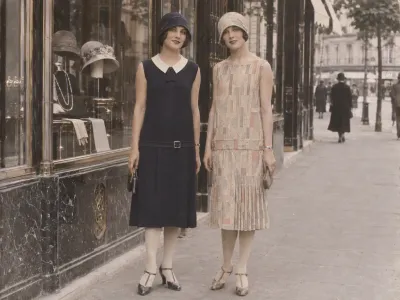
That was the trick of the late 1920s. Skirts had reached their shortest by about 1926-28, just below the knee, and the uneven hem let designers suggest length without committing to it. The V&A puts it plainly in its label for a mustard-yellow georgette evening outfit made by the London house Nabob in about 1927: "Skirts with handkerchief points were especially fashionable in the later 1920s. They were forerunners of the longer skirts which became generally accepted by 1929." Even Jean Patou, the great promoter of sporty short skirts, showed a white crêpe evening gown with "an uneven hemline" in his 1927 collection, according to the dress historian Amy de la Haye.
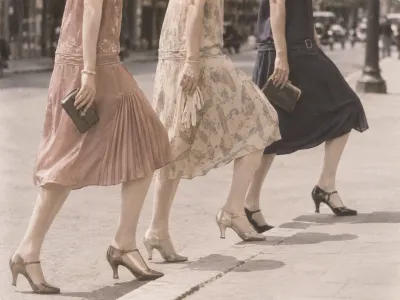
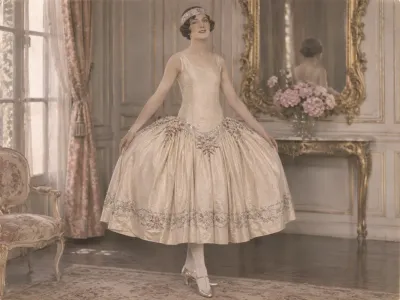
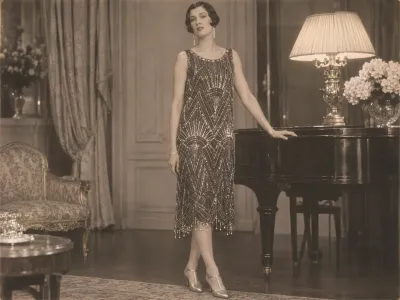
The name describes the simplest version. Take a square of light fabric, cut a hole for the hips at its centre, and the corners fall in four points while the edges between them ride higher. Hung from a dropped waist, that gives a hem that swings between knee and calf. Most real skirts were built more cleverly, from several squares, triangles or circular pieces set into the hip seam so that the points overlapped. Other designers used panels instead. A pale pink crêpe evening dress designed by Madeleine Wallis for Paquin in 1928 has a hem at or just below the knee, but the skirt is slit to the hip at the centre front and to the waist at the side, and a rose-pink satin band falls loose from the waist on either side of the bodice. A gilt net evening dress of about 1929, also in the V&A, goes further: a full bias-cut skirt, applied with velvet panels, that is longer at the back and finished with a scalloped hem. Trains did the same job on formal dresses. Erica Ferguson's wedding dress from Debenham & Freebody, worn in January 1926, is ankle-length and loose, but a rectangular train of the same gold chiffon velvet hangs from her shoulders.
Here is the construction problem, and every dressmaker who has made one knows it. A point is cut partly on the bias, and bias stretches. The New Butterick Dressmaker of 1927 warned that a circular skirt, flounce or godet "will always stretch more or less", and told readers to baste the garment together and "let it hang for two or three days at least" before turning up the hem, ripping out a godet's bias-edged seams so the edge could "fall naturally", then marking the drop and turning the edge on the person who would wear it. I still do exactly that. On chiffon the edge itself had to be tiny, and the same manual describes chiffon edges picoted, or rolled and whipped, finishes light enough not to drag a point out of shape.
The uneven hem was a bridge, and it didn't last long. Patou was already showing a coat and skirt "with godet" for winter 1928, and as the waist went back up, the floating points settled into the shaped godets and flared hems of the next decade. By 1930, as the return of the natural waist describes, the hem no longer needed to suggest length. It simply had it.
Sources
- Wedding dress and veil, embroidered silk and tulle, retailed by Cope of Harrogate, 1928 (T.374&A-1990) - V&A Collections
- Evening outfit of silk georgette with silver-gilt embroidery, Nabob, London, ca. 1927 (T.144 to C-1967) - V&A Collections
- Evening dress of beaded and embroidered crêpe, Madeleine Wallis for Paquin, 1928 (T.100-1968) - V&A Collections
- Evening dress, gilt net with applied velvet panels, English or French, ca. 1929 (T.110-1938) - V&A Collections
- Wedding dress with attached train, silk chiffon velvet, Debenham & Freebody, London, 1926 (T.16:1-2013) - V&A Collections
- Amy de la Haye, "Patou, Jean", Encyclopedia of Clothing and Fashion - Encyclopedia.com
- The New Butterick Dressmaker (Butterick Publishing Company, 1927) - Internet Archive