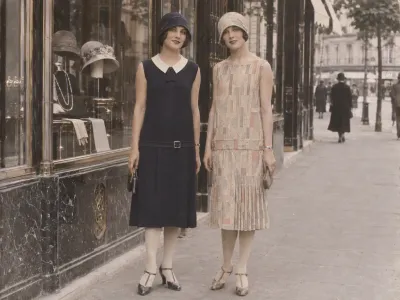
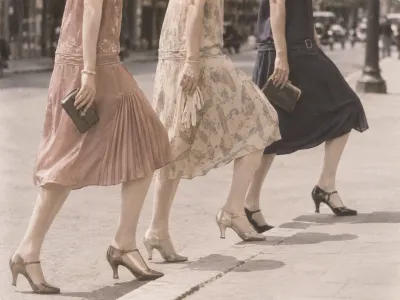
The 1920s throughout the 1920s
Jean Patou
Sportswear, six American mannequins, a dress with a light bulb in it: how Jean Patou turned 7 rue Saint-Florentin into the house that ran Chanel closest in the 1920s.
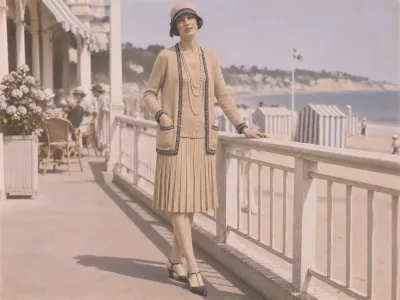
The Palais Galliera has a short jacket that Patou showed in 1922, in red and black wool cloth lined with white silk serge printed in black, with black ribbon criss-crossed at the collar, the wrists and the waist. A number is inked on a tape at the back, and the label is woven with his address: 7 rue Saint-Florentin. He had started out before the war as Maison Parry (sources date it anywhere from 1912 to 1914), and in 1919 he reopened under his own name. The jacket appeared in Femina that June, and it is a good emblem of his decade: smart, workmanlike and made to be moved in.
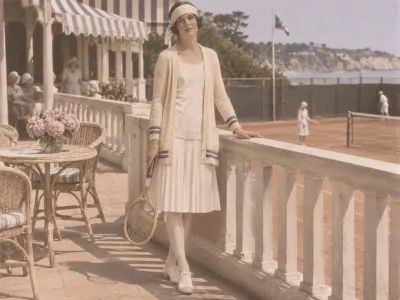
Sport made him. Suzanne Lenglen wore a Patou tennis dress in 1921, and FIT notes that much of what her later licensed label sold in America adapted couture sportswear made for her by Patou and other French houses (the 1930s Patou entry tells the Wimbledon story). The house built its reputation on comfortable jersey ensembles, golf and tennis clothes and swimsuits, sold through its own sports boutique, Le Coin des Sports. He is often credited with the first designer monogram, on knitwear and bathing suits, and the sportswear silhouette owes him a great deal. The documented trail is thinner than the claim, though. The historian Caroline Evans found his initials embroidered on handkerchiefs in the wardrobe he made for the Dolly Sisters' American tour in 1924, and judged that a designer splashing his name across the front of a dress, as he did in 1925, was "a new departure."
That dress is in the Metropolitan Museum, and it is my favourite object of the decade. Called "Advertising," it is a navy silk faille two-piece: a long-sleeved blouson top with two patch pockets over a knee-length pleated skirt. An Eiffel Tower is embroidered in red on the front, with a waterfall of pleated white chiffon falling from its base, and at the top sits a tiny electric bulb. The battery rides in one pocket, a Bakelite switch in the other, and the wires run up inside the blouse through small holes stitched into the pockets from the inside. Patou registered the design on 21 August 1925. On the model, the tower carried the word PATOU; the Met's copy, bought in 1930 by the New York socialite Molly Cogswell, has her monogram instead.
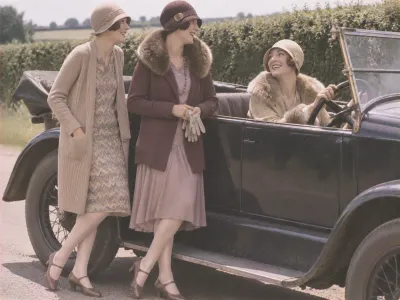
America was his market, and he courted it openly. In late 1924 he recruited six American mannequins in New York, wanting what FIT calls his "American Diana," slim and athletic, rather than the curvier "French Venus." They made their debut on 5 February 1925 alongside his French models. One of them, Lillian Farley, remembered the heat and perfume of that press night, at which "twenty of us had shown five hundred models." Patou had begun staging his press shows as evening parties in 1923, and a New York Times writer mentioned the "strong opposition" to the Americans. He said he was captivated by their "flapper walk," and two of them were only sixteen and seventeen, the modern girl in person.
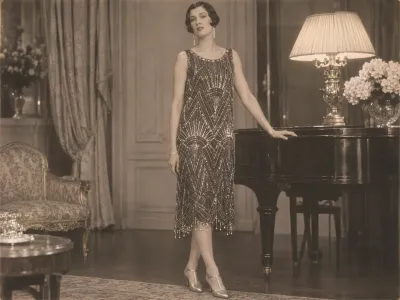
Evening was just as rich. "Byzance," a 1924 dress at the V&A, is oyster georgette worked all over in pink, gold and bronze beads and baroque pearls, with a pattern the museum links to Egyptian design, and a mid-1920s evening cloak in honey-gold velvet is densely smocked round the shoulders and collared in mink. The V&A credits him, with Chanel, as a leading exponent of the garçonne look, and as the decade's steadiest champion of short skirts. The rivalry with Chanel was real: Vogue's Edna Woolman Chase said he saw her as his "real blood enemy," and Evans notes that he gave his models French names where Chanel only numbered hers. It ended with Patou leading the drop in hemlines in 1929, the turn the 1930s entry takes up.
Sources
- Caroline Evans, "Paris-New York 1925: Jean Patou's 'Advertising'", in Fashion and Modernism (Bloomsbury, 2018) - UAL Research Online
- "Advertising" ensemble, House of Patou, first designed 1925, purchased 1930 (1995.212a-d) - The Metropolitan Museum of Art
- Jacket, Jean Patou, 1922 (GAL 1988.146.1) - Palais Galliera, Paris
- Evening dress 'Byzance', Jean Patou, 1924 (T.198-1970) - V&A Collections
- Evening cloak, Jean Patou, mid-1920s (T.1590-2017) - V&A Collections
- Jean Patou (1880-1936), biography - The Museum at FIT eMuseum
- Tennis in the '20s - Material Mode, FIT Special Collections and College Archives blog, 2015