The 1920s throughout the 1920s
Jeanne Lanvin
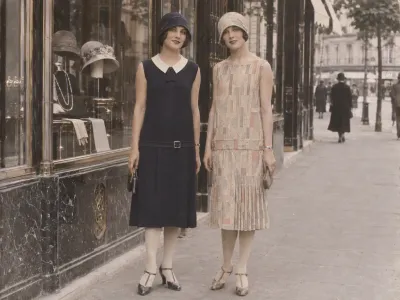
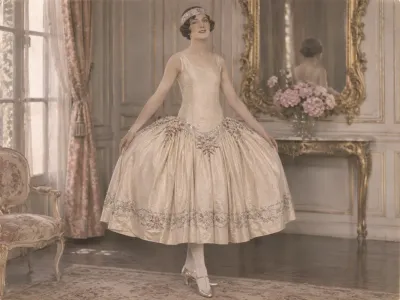
A milliner who began by dressing her daughter, Lanvin spent the 1920s defying the boyish line with full-skirted robes de style, her own embroidery workrooms and a favourite Fra Angelico blue.
Sewn into a black silk taffeta evening dress at the V&A is a woven label in cream, black and pink, and beside it another reading "HIVER 1922-1923." The dress has a shallow boat neckline and little capped half-sleeves gathered into the armholes, and a long, full skirt gathered on below a plain bodice. Two enormous fern fronds are machine-embroidered across the front in furry cream chenille, and cream georgette bows trail streamers from the right sleeve and the left of the waist. It fastens with poppers down the left side. What I love is the finishing: the neckline, armholes, sleeve edges and hem are all bound with narrow strips of the same taffeta, which on a cloth this light is neater than any turned hem. The museum's label puts the point plainly. Many of Lanvin's 1920s designs were full-skirted and feminine "at a time when her fellow couturiers were issuing boyish, tubular clothes."
She came to couture sideways. Jeanne Lanvin began as a milliner in 1885 and opened her own hat shop in 1889, at 16 rue Boissy d'Anglas, according to the 2015 Palais Galliera retrospective (the V&A gives 1890 and the rue du Faubourg Saint-Honoré, where she moved in 1893). Her only daughter, Marguerite, born in 1897, became what the retrospective calls her primary source of inspiration, and in 1908 Lanvin launched children's clothes. A department for young ladies and women followed the next year, then bridal wear, lingerie and furs. The house's logo, drawn by Paul Iribe, shows the couturière with her daughter, and Arpège, the perfume of 1927, was made for Marguerite's thirtieth birthday. Few houses have been so openly founded on a mother dressing a girl.
The dress that made her name in the 1920s was the robe de style: a simple bodice, often with the decade's low waist, over a wide skirt that borrowed its breadth from eighteenth-century court dress. The V&A's white example of 1922-23 is all layered silk organza ruffles, with a posy of silk flowers on the bodice. It belonged to the Spanish actress Catalina Bárcena, who commissioned a whole run of Lanvin dresses, wore them on stage and off, and lent her name to the house's advertisements. The museum notes that the style was popular with women of all ages, which says something about who wasn't served by the garçonne ideal.
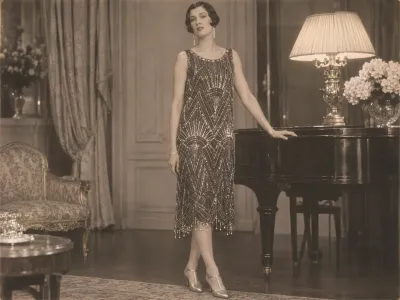
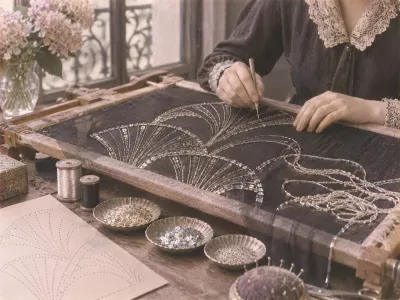
The workrooms were the engine. By 1918 Lanvin owned the whole building at 22 rue du Faubourg Saint-Honoré, with dressmaking, tailoring, embroidery, lingerie, millinery and design workrooms under one roof; by 1925 there were 23 workshops and 800 staff, not counting the sales team. She maintained that her embroideries were the foundation of her collections. Her favourite colour, the intense quattrocento blue usually called Lanvin blue, came from the frescoes of Fra Angelico. A turquoise georgette dress of 1925 at the V&A, beaded in turquoise, black and clear glass with crosses and streamers, arrived in 1967 described as Callot Soeurs; only later research identified it as Lanvin, a reminder of how close the great houses' beadwork could be.
Her public peak came at the 1925 Exposition. Lanvin was vice-chair of its organising committee, and she chaired both Classe 20 (clothing) and the international awards jury, choosing the exhibitors and commissioning the décor from the architect Robert Fournez and from Armand-Albert Rateau, her partner in the interiors firm Lanvin Décoration since 1921. Seventy couturiers showed in the Grand Palais; the Pavillon de l'Élégance on the Cours-la-Reine was reserved for just four houses, Lanvin, Callot, Jenny and Worth, plus the jeweller Cartier. A summer day dress of about 1928, in duck-egg blue crêpe with pin tucks and drawn threadwork, shows the quieter side of the house as the decade ended, and by 1935 she was cutting satin on the bias like everyone else.
Sources
- Evening dress, Jeanne Lanvin, winter 1922-23 (T.334-1978) - V&A Collections
- 'Robe de Style', Jeanne Lanvin, 1922-23 (T.54-2013) - V&A Collections
- Evening dress, Jeanne Lanvin, 1925 (T.151&A-1967) - V&A Collections
- Day dress, Jeanne Lanvin, ca. 1928 (T.141-1967) - V&A Collections
- Jeanne Lanvin (1867-1946) - Musée des Arts Décoratifs, Paris
- The International Exposition of Modern Decorative and Industrial Arts, Paris 1925 - Musée des Arts Décoratifs, Paris
- Jeanne Lanvin (Palais Galliera, 2015) - Exhibiting Fashion, University of the Arts London