The 1920s early to mid-1920s
Callot Soeurs
Four sisters, a lace shop and a house famed for gold lamé and Chinese silks: Callot Soeurs trained Vionnet, dressed duchesses and still stood among Paris's elite in 1925.
On 22 November 1922 the Ranee of Pudukota, born Mollie Fink, went to the wedding of the Princess Royal in a Callot Soeurs afternoon dress. It is cream silk chiffon, finely pleated, hanging straight from a narrow band collar, with wide sleeves, a bodice front and a deep hem all of gold lace, fastened at the centre front with tiny gold filigree buttons. The open sides are bound with brown satin ribbon. Her son later said she took great care not to offend Queen Mary with anything too low-cut. The next year she wore Callot again, at court: white satin woven in gold with trees and pagodas, edged in gold and pearl embroidery on net, with a pearl tassel at the low waist. Both are now in the V&A, and together they sum up the house: lace, gold, the East, and absolute propriety.
Callot Soeurs was a family firm in the full sense. The four sisters, Marie, Marthe, Régina and Joséphine, grew up with a lace-maker mother and a father who painted and taught design (one V&A record also calls him an antique dealer). They began with a small shop selling lace, ribbons and lingerie, and in 1895 opened a salon on the rue Taitbout, making blouses and lingerie from antique lace; another V&A record dates the lace shop to 1888. Joséphine died in 1897. The eldest, Marie Callot Gerber, who had worked at the dressmaking house of Raudnitz, became head designer, and in 1914 the house moved to grander rooms on the avenue Matignon. It belongs in the line of women-run houses that includes Jeanne Paquin, and by the 1920s Lanvin, Chanel, Vionnet and Jenny had joined it on the doors of Paris couture.
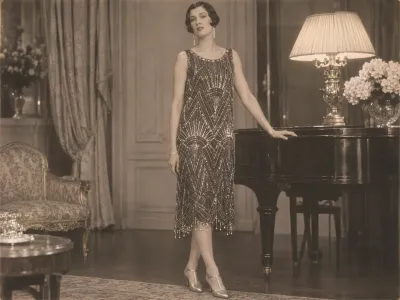
Its look came from Marie. The ASU FIDM Museum says she grew more adventurous after exploring Asian art through her friend Edmond de Goncourt, and the house drew on Chinese, Japanese, Indian and Moroccan sources: kimono sleeves, tasselled girdles, embroidered satin panels, black cloth with the sheen of lacquer. The V&A counts them among the first to make dresses of lamé, a fabric the 1930s would adore. Their 1920s evening dresses are a catalogue of surface. A green satin of 1922-25 carries a single huge Chinese-style flower. A printed silk voile of about 1922, worn by Winifred, Duchess of Portland, has sequins and bugle beads following the printed flowers so the pattern catches the light, over a lamé petticoat. The Museum at FIT has a gold lamé gown of 1921 with beads dangling at the centre of the bust and a draped overskirt edged in turquoise beading.
That surface sat on serious dressmaking, and the best witness is Madeleine Vionnet, who worked there as a young dressmaker before opening her own house. Museum texts at FIT and FIDM quote her as saying, "Without the example of the Callot Soeurs, I would have continued to make Fords." The longer version usually repeated, that Callot taught her to make Rolls-Royces, adds the other half of the comparison, but I haven't found it in a museum source. Proust paid a compliment too: in In Search of Lost Time Albertine notes that the difference between a Callot dress and an ordinary one is "enormous," visible only to those who know.
The house was still at the top in 1925. At the Paris Exposition, the Pavillon de l'Élégance was reserved for just four couture houses, Callot, Lanvin, Jenny and Worth, beside the jeweller Cartier. Yet the family was thinning out. After Marthe's death and Régina's retirement in 1920, Marie ran the house alone; she died in 1927, and her son Pierre Gerber took over. Accounts of the end differ: FIDM cites a 1933 Women's Wear Daily report of the house closing, while the V&A says it was absorbed by Calvet in 1937. Either way, the sisters' house barely outlived the decade of slim beaded dresses it had helped to define.
Sources
- Afternoon dress, Callot Soeurs, 1922 (T.217&A-1962) - V&A Collections
- Court dress, Callot Soeurs, 1923 (T.216&A-1962) - V&A Collections
- Evening dress, Callot Soeurs, 1922-25 (T.73-1958) - V&A Collections
- Evening dress, Callot Soeurs, ca. 1922 (T.74 to B-1974) - V&A Collections
- Callot Soeurs - ASU FIDM Museum
- Callot Soeurs (exhibition, 2007-08) - The Museum at FIT and Chicago History Museum
- The International Exposition of Modern Decorative and Industrial Arts, Paris 1925 - Musée des Arts Décoratifs, Paris