The 1920s throughout the 1920s
Madeleine Vionnet
Greek vases, Thayaht's logo, a mansion on the avenue Montaigne and a running war with copyists: the business side of the decade Vionnet perfected her cut.
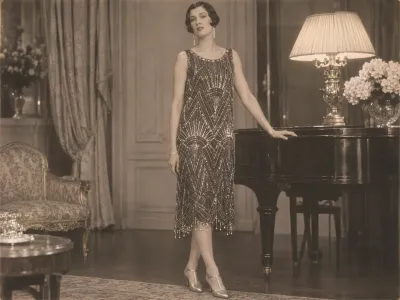
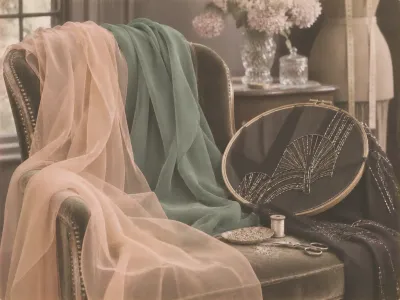
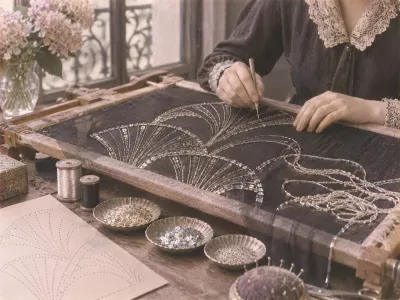
Vionnet's model number 1113, for winter 1921-22, is a dress of brick-red crêpe romain embroidered with horses. They rear through bands of waves worked in blue and black bugle beads, outlined in round black beads and gold metallic thread. The house called it the "Robe à petits chevaux" or "Robe au vase grec," and the second name is exact. Vionnet had hired a young designer, Marie-Louise Favot, known as Yo, for her surface decoration and encouraged her to study antique vases; a photograph in the Vionnet archive shows that Yo worked from the Pronomos Vase in Naples, where actors' robes carry rearing horses between bands of waves. The embroidery came from the workshop of Albert Michonet, which Albert Lesage later took over (he married Yo). Betty Kirke, the Vionnet scholar who knew the designer, said it was one of her favourites.
The technique behind these clothes, the bias and the half-scale wooden doll she draped on, belongs to the 1930s entry and the bias cut page. This one is about the house. Vionnet had trained with Callot Soeurs and opened on her own in 1912, closing for the war in 1914. She reopened in 1918 according to the 2009 Paris retrospective, or 1919 according to the Museum at FIT. In 1923 she moved into a private mansion at 50 avenue Montaigne, where Georges de Feure decorated the salons in the Art Deco style; his fresco for the black-and-white presentation salon included the little horse dress among its antique-style beauties. The new building had a canteen, a free medical and dental practice for staff and their families, a crèche, and paid and maternity leave more generous than the law required.
Antiquity ran through the decade's work. The artist Thayaht, who worked with her from 1919 to 1925 on surface designs and drew her clothes for the Gazette du Bon Ton, gave her a logo in 1919: a woman inside a circle, standing on an Ionic column, arms raised, holding up her peplos. The Palais Galliera has a 1924 evening dress that repeats it in embroidery, layered panels of green-shaded silk mousseline worked in copper thread, white beads, green bugles and rhinestones, with long trompe-l'œil sautoirs. The V&A's "La Fleur" of about 1922 is gentler: a lilac lawn summer dress made of overlapping scalloped petals mounted on tulle, each appliquéd with a little pot of flowers. That's a great many separate pieces, each edge finished, for a dress that looks effortless.
The business problem was copying. Department stores and manufacturers paid sketchers to steal models at the shows, and Vionnet fought back on every front. In 1921 she founded an association for the defence of the plastic and applied arts, photographed each model from front, back and sides for her copyright albums, and put her fingerprint on her labels. She also licensed. From 1922 the studio of Eva Boëx on the rue de Castiglione could reproduce her designs if it sold at least three of each, and the curator Pamela Golbin found that Vionnet had owned the firm since 1921. In February 1924 she set up Madeleine Vionnet Inc. at Hickson's in New York, with exclusive American reproduction rights, and Kirke reports that she wore the red horse dress to the opening.
The horses show how the battle went. Berlin's Kunstgewerbemuseum, whose curator Christine Waidenschlager has traced the design, owns a probable authorised copy in dark blue crêpe romain, simplified to the looser cut of 1924-26, and an unauthorised one whose embroidery has dissolved into shapeless blobs, as if sketched from a glimpse. In 1922 the Berlin house of Johanna Marbach advertised an exact copy (most likely a licensed one) in Die Dame as its own model. None of the copies attempts the original's cut. What sold was the instantly recognisable beadwork, proof that in the 1920s a pattern could travel where a construction could not.
Sources
- Christine Waidenschlager, "From Haute Couture Model to Best-Seller: Madeleine Vionnet's 'Little Horse Dress'" (ICOM Costume Committee, London 2017 proceedings) - Kunstgewerbemuseum, Staatliche Museen zu Berlin
- Robe du soir, Madeleine Vionnet, 1924 (1992.19.1) - Palais Galliera, Paris
- Madeleine Vionnet, puriste de la mode (Les Arts Décoratifs, 2009-10) - Fashion Exhibition Making, University of the Arts London
- Madeleine Vionnet evening gown - ASU FIDM Museum
- Day dress 'La Fleur', Madeleine Vionnet, ca. 1922 (T.444&A-1974) - V&A Collections
- Vionnet (1876-1975), biography - The Museum at FIT eMuseum
- The Poetry of the Bias: Madeleine Vionnet - European Fashion Heritage Association, 2019